By Brian French | JacksonvilleBusinessNews.com | October 24, 2026
Quick Answer
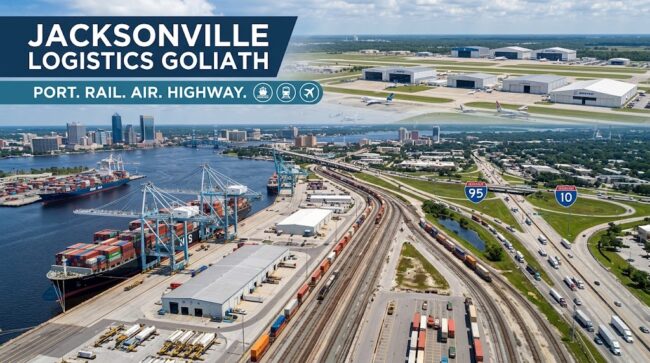
Jacksonville is a rare four-mode logistics hub: a 47-foot deepwater port, three railroads running about 40 daily trains, the I-95/I-10 interstate junction, and two cargo-capable airports. JAXPORT moved nearly 1.4 million container TEUs in fiscal 2025, and new projects at Blount Island, JIA and Cecil Airport are adding capacity.
Key Takeaways
| Metric | Figure | Source |
|---|---|---|
| JAXPORT container volume, FY2025 | ~1.39 million TEUs | JAXPORT |
| Vehicle units, FY2025 | ~506,000 | JAXPORT |
| Total cargo, FY2025 | 10.2 million tons | JAXPORT |
| Harbor depth | 47 feet | JAXPORT |
| Air draft after Fulton Cut project | 205 feet (from 175) | JAXPORT / JEA |
| Daily trains serving Jacksonville | ~40 | JAXPORT |
| Blount Island modernization | $250 million | JAXPORT |
| Port-supported jobs / economic impact | 258,800 / $44 billion | JAXPORT |
The Gateway to the Southeast
Direct answer: Jacksonville’s logistics advantage is integration. Ships, trains, trucks and aircraft converge within a few miles, giving shippers multiple ways to move cargo into the Southeast and beyond. JAXPORT says the port offers same-day truck access to 98 million U.S. consumers, with two Class I railroads and two interstate corridors.
Four Modes, One Market
Most U.S. port cities are strong in one or two modes. Jacksonville’s pitch to shippers is that it offers all four at scale, with relatively little congestion.
| Mode | Key Assets | Strength |
|---|---|---|
| Ocean | JAXPORT terminals at Blount Island, Dames Point, Talleyrand | Containers, vehicles, breakbulk, Puerto Rico trade |
| Rail | CSX, Norfolk Southern, Florida East Coast Railway | Eastern and Central U.S. reach |
| Highway | I-95, I-10, I-295 beltway | North-south and east-west corridors |
| Air | Jacksonville International (JIA), Cecil Airport | E-commerce cargo, aerospace, MRO |
JAXPORT describes itself as Florida’s No. 1 container port by volume and one of the nation’s top vehicle-handling ports. The port’s two-way ship traffic means vessels do not have to wait for each other to pass in the channel, a meaningful efficiency compared with some single-lane harbors.
The Rail Backbone
Rail is where Jacksonville quietly outperforms many larger port markets. According to JAXPORT, the city is served by:
- About 40 daily trains across two Class I railroads, CSX and Norfolk Southern, plus the regional Florida East Coast Railway
- Two intermodal container transfer facilities: an on-dock yard at Talleyrand Marine Terminal and a near-dock yard at Dames Point
- About 40 rail freight stations in Duval County
- The highest and widest port rail clearance on CSX’s national system, at 20 feet high and 13 feet wide
That clearance matters for oversized and project cargo. So does Blount Island’s heavy-lift berth, which JAXPORT says ranks among the nation’s highest weight-bearing docks at up to 2,000 pounds per square foot.
Jacksonville is also the headquarters city for CSX, one of the largest railroads in North America, which gives the region unusual proximity to rail decision-makers.
The Interstate Junction
Interstate 95 runs the length of the East Coast, and Interstate 10 begins in Jacksonville and runs west to Southern California. That junction, combined with the I-295 beltway, explains why so many national retailers and e-commerce companies have built distribution centers in the region. JAXUSA Partnership has cited Amazon, Wayfair and Walmart among companies choosing Jacksonville to reach customers throughout the Southeast.
JAXPORT Expansion and Container Capacity
Direct answer: JAXPORT completed its 47-foot harbor deepening and a $250 million Blount Island modernization, and is finishing a project to raise power lines over the St. Johns River to 205 feet of clearance by the end of 2026. Together, these let larger container ships reach the port fully loaded.
Five Years of Volume
| Fiscal Year | Container TEUs | Vehicle Units | Total Tons |
|---|---|---|---|
| FY2021 | 1,407,310 | 616,215 | 10.34M |
| FY2022 | 1,298,132 | 553,029 | 9.96M |
| FY2023 | 1,313,487 | 505,665 | 10.35M |
| FY2024 | 1,340,412 | 509,091 | 10.05M |
| FY2025 | 1,388,841 | 506,237 | 10.23M |
Source: JAXPORT statistics. Fiscal year begins October 1.
Container volume has recovered steadily since its 2022 dip and is approaching the FY2021 peak. Breakbulk tonnage was a standout in FY2025, rising to about 976,000 tons from about 808,000 the year before. Vessel calls reached 1,611, the highest in the five-year series.
Harbor Deepening: Done
The federal-local project to deepen the Jacksonville shipping channel to 47 feet was completed through the Blount Island terminal, allowing larger post-Panamax ships to call with heavier loads. Depth alone was not enough, however. Ships also need vertical clearance.
The Air Draft Project: Finishing in 2026
Large container ships must pass beneath power lines crossing the St. Johns River at Fulton Cut, near Blount Island. JEA, working with JAXPORT, the City of Jacksonville and the Florida Department of Transportation, is raising those transmission lines from 185 feet to 225 feet. That provides 205 feet of operational clearance, up from 175 feet.
Funding came together in early 2023, including a $22.5 million FDOT grant, a $10 million city grant, and city loans to be repaid by JAXPORT. Helicopter crews began installing new conductors between Blount Island and Reed Island in 2026, and the work remains on track for completion by the end of the year, according to JAXPORT and JEA.
JAXPORT says international container trade in Jacksonville supports about 15,000 regional jobs. The air draft project is designed to protect and grow that business by allowing more of the largest ships in the Asia and Indian Subcontinent trades to call.
Blount Island Modernization
At the 2026 State of the Port address, JAXPORT CEO Eric Green highlighted the completion of a $250 million modernization of Blount Island’s container and auto-handling capabilities. Two pieces anchor it:
- The SSA Jacksonville International Container Terminal, a modernized container facility on Blount Island
- A new Southeast Toyota Distributors vehicle processing facility, reinforcing Jacksonville’s role as a major auto port
The port also lists 100-gauge cranes and berth enhancements among its recent improvements.
Trade Routes Are Shifting
JAXPORT’s trade mix is changing in ways supply chain planners should note. According to data presented at the 2026 State of the Port and reported by Jacksonville Today:
| Origin | 2023 Containers | 2025 Containers | Trend |
|---|---|---|---|
| India | 5,881 | 12,387 | More than doubled |
| Malaysia | 3,444 | 8,665 | Up 151% |
| China | Declining | 41,060 | Lower share |
Most of JAXPORT’s Asian traffic moves through the Panama Canal rather than the Suez Canal, which helped insulate shippers during Red Sea disruptions. The port also handled about 650,000 metric tons of imports from Puerto Rico and about 686,000 metric tons from Canada in FY2025.
Jacksonville has long been the primary U.S. mainland gateway for Puerto Rico trade, with carriers such as Crowley and TOTE running regular services.
The Green Fuel Advantage
Jacksonville became an early leader in liquefied natural gas as a marine fuel. TOTE and Crowley launched LNG-powered vessels serving the Puerto Rico trade from Jacksonville, and the port hosted the first foreign-flagged vessel to bunker LNG at a U.S. port. In 2020, JAXPORT described itself as the only U.S. East Coast port offering both on-dock and near-dock LNG fueling. For ocean carriers facing tighter global emissions rules, fuel availability is a real routing consideration.
Aviation and Air Freight Dynamics
Direct answer: Jacksonville’s airports serve two distinct logistics roles. Jacksonville International (JIA) handles passenger belly cargo and e-commerce freight, with an Amazon Air hub set to open in late 2026. Cecil Airport is becoming an aerospace manufacturing and maintenance cluster, anchored by Boeing and a planned Otto Aerospace jet factory.
JIA: E-Commerce Arrives
The biggest air cargo development of 2026 is Amazon Air. The Jacksonville Aviation Authority (JAA) reached an agreement for Amazon to lease the 50,000-square-foot Air Cargo Building Four at JIA, with operations expected to begin in the fourth quarter of 2026. The city issued a renovation permit in May.
JAA officials noted it will be Amazon’s first air cargo operation in Northeast Florida. Until now, the nearest Amazon Air facility was in Tampa, with shipments trucked north. A local air hub should speed delivery for some product lines and strengthens Jacksonville’s role in Amazon’s network, which already includes 12 facilities in the city, according to the Jacksonville Daily Record.
JIA is also expanding its passenger footprint. The JAA’s Concourse B project carries a budget of about $243 million for the concourse itself and more than $300 million for broader airport renovations, according to Action News Jax, adding six gates. More passenger flights generally mean more belly cargo capacity.
Cecil Airport: The Aerospace Play
Cecil Airport, the former Naval Air Station Cecil Field on the Westside, is where Jacksonville’s aviation strategy is most ambitious.
| Tenant or Project | Activity | Status |
|---|---|---|
| Boeing Cecil Field | Military aircraft MRO | Expanding under 25-year JAA lease |
| Otto Aerospace | Phantom 3500 business jet HQ and factory | Hangar work underway; plant construction targeted for 2028 |
| Hermeus | High-speed aircraft testing facility | Planned, per JAA |
| Cecil Spaceport | Licensed horizontal launch site | JAA funding reentry license work |
| Army Reserve | Proposed training complex nearby | Early filings, 2026 |
Boeing expanded its maintenance, repair and overhaul operations at Cecil under a 25-year lease with the JAA, with the authority constructing new facilities on about 30 acres. Reporting at the time projected about 400 additional jobs.
Otto Aerospace (formerly Otto Aviation) announced in June 2025 that it would move its headquarters from Fort Worth and build a manufacturing facility at Cecil for its Phantom 3500 business jet. State announcements cited more than $430 million in capital investment, an 850,000-square-foot factory on 80 to 100 acres, and 389 jobs averaging $90,388 a year. Incentives included a $34.9 million JAA package, up to $20 million from the city, and state tax credit and High Impact Performance Incentive support.
Timelines have stretched. Otto is starting in the renovated Hangar 825, a former Navy facility, and a JAA executive told City Council’s Finance Committee this year that factory construction is targeted for 2028 with aircraft production around 2030. Fractional operator Flexjet has ordered 300 Phantom 3500s, according to aviation trade reports.
City policy now favors Cecil. In August 2026, City Council approved a resolution requiring the Office of Economic Development to give additional positive consideration to incentive requests for projects at Cecil Field.
Why MRO Matters for Logistics
Maintenance, repair and overhaul work is not glamorous, but it anchors skilled jobs and supplier networks. JAA CEO Mark VanLoh has said airlines need facilities to repair and upgrade aircraft, and that Jacksonville is well positioned because of its workforce and cost advantages. The region’s Navy presence, including Naval Air Station Jacksonville and Naval Station Mayport, adds a deep pool of aviation technicians.
The Future of Autonomous Freight
Direct answer: Jacksonville’s supply chain is adopting automation in stages. Modernized terminals, digital gate and yard systems, LNG-fueled vessels and electric yard equipment are arriving now. Fully autonomous trucks and drone delivery remain early-stage nationally, so local shippers should pilot selectively and invest first in data and visibility.
What Is Real Today
Automation in Jacksonville’s logistics network is mostly happening inside the fence, where conditions are controlled:
- Terminal modernization at Blount Island, including new cranes and upgraded container handling
- Digital yard and gate management, which uses software to schedule truck arrivals, track containers and reduce dwell time
- Warehouse automation in large regional distribution centers, including robotics, sortation and AI-driven slotting
- Cleaner fuels, led by LNG-powered ocean vessels and a growing shift to electric forklifts and yard tractors
Jacksonville also has hands-on experience with autonomous vehicles in a different context. The Jacksonville Transportation Authority launched autonomous passenger service on the three-mile Bay Street Innovation Corridor in 2025, giving the region a regulatory and operational track record with self-driving vehicles on public streets.
What Is Still Emerging
| Technology | Maturity | Jacksonville Relevance |
|---|---|---|
| AI yard and dock scheduling | Deployed widely | High: reduces truck turn times |
| Warehouse robotics | Deployed widely | High: large DC base |
| Electric yard tractors | Growing | Medium-high: terminal and DC yards |
| LNG marine fuel | Established locally | High: Puerto Rico and auto trades |
| Autonomous long-haul trucks | Early commercial pilots nationally | Medium: I-10 and I-95 corridors are candidates |
| Drone delivery | Limited | Low-medium for B2B freight |
The I-10 corridor between Jacksonville and Texas is the kind of long, interstate-heavy route autonomous trucking companies have targeted nationally. Whether and when that reaches Jacksonville at scale depends on federal and state rules, insurance, and carrier economics.
How Shippers Should Prepare
For Jacksonville logistics operators and shippers, the practical steps are less about buying robots and more about readiness:
- Digitize data first. Container, appointment and inventory data must be clean before automation can use it.
- Use port and rail visibility tools. Real-time tracking reduces demurrage and detention costs.
- Pilot in controlled spaces. Yards, warehouses and terminals offer the fastest return.
- Plan for alternative fuels. LNG, electric and renewable diesel options are expanding in the region.
- Build workforce skills. Technicians and data-savvy supervisors will be in shorter supply than equipment.
JAXUSA Partnership’s transportation and logistics talent work, including educator externships with JAXPORT, CSX, Suddath and Amazon, reflects how central workforce has become to the region’s logistics strategy.
Brian’s Take
Investors like assets that are hard to replicate, and Jacksonville’s logistics network fits that description. You cannot easily build a new 47-foot harbor, a Class I railroad headquarters, an interstate junction and a former Navy master jet base in one metro. Jacksonville already has them, and the past five years of investment have been about removing bottlenecks rather than starting from scratch.
The air draft project is a good example. It is a power line, not a ribbon-cutting headliner, but it determines which ships can reach Blount Island. Those quiet constraints often decide where cargo goes.
The risk to watch is execution at Cecil. Aerospace manufacturing is long-cycle and capital-intensive, and Otto’s timeline has already moved. The region is effectively underwriting capacity ahead of a certified product. That can pay off handsomely, but businesses planning around Cecil’s growth should build in patience.
For shippers, the near-term story is simpler: more vessel access, a new Amazon air hub and steady container growth. Jacksonville is becoming a more complete gateway each year.
Frequently Asked Questions
What makes Jacksonville a major logistics hub?
Jacksonville combines a 47-foot deepwater port, about 40 daily trains on CSX, Norfolk Southern and Florida East Coast Railway, the I-95 and I-10 interstate junction, and two cargo-capable airports. JAXPORT says the port offers same-day access to 98 million consumers.
How much cargo does JAXPORT handle?
In fiscal 2025, JAXPORT moved about 1.39 million container TEUs, about 506,000 vehicle units and roughly 10.2 million tons of total cargo, with 1,611 vessel calls.
What is the JAXPORT air draft project?
JEA is raising power lines over the St. Johns River at Fulton Cut from 185 feet to 225 feet, giving ships 205 feet of operational clearance. The project is on track for completion by the end of 2026 and lets larger container ships reach Blount Island.
Is Amazon opening an air cargo hub in Jacksonville?
Yes. Amazon Air leased the 50,000-square-foot Air Cargo Building Four at Jacksonville International Airport, with operations expected to begin in the fourth quarter of 2026.
What is happening at Cecil Airport?
Cecil is developing as an aerospace hub. Boeing is expanding military aircraft maintenance there, Otto Aerospace is establishing its headquarters and plans a Phantom 3500 jet factory, and the JAA is advancing spaceport licensing and other aerospace projects.
Which countries are growing fastest in JAXPORT trade?
India and Malaysia have grown sharply. Containers from India more than doubled between 2023 and 2025, and containers from Malaysia rose 151%, while China’s share declined.
Are autonomous trucks operating in Jacksonville?
Not at scale. Autonomous long-haul trucking is still in early commercial pilots nationally. Jacksonville does operate autonomous passenger shuttles Downtown, and automation is advancing faster inside ports, rail yards and warehouses.
Sources and Further Reading
- JAXPORT, “JAXPORT Highlights Infrastructure Progress and Long-Term Strategy at 2026 State of the Port” (February 26, 2026)
- JAXPORT, Media Statistics, fiscal years 2021–2025
- JAXPORT, Rail Connections
- JAXPORT, statement on securing full funding for raising the Fulton Cut powerlines (January 11, 2023)
- JAXPORT / JEA, “Helicopter Operations Support Next Phase of Fulton Cut Power Line Project” (2026)
- Marine Log, “Helicopter ops mark next step in JAXPORT air draft improvement project” (2026)
- Container News, “Jacksonville advances air draft project for larger container ships” (July 2026)
- Jacksonville Today, “JAXPORT shippers rely less on Red Sea during turmoil” (February 27, 2026)
- Jacksonville Daily Record, “Amazon to operate air cargo hub at Jacksonville International Airport” (February 2, 2026)
- Jacksonville Daily Record, “Amazon air cargo hub taking off at JAX” (May 20, 2026)
- Action News Jax, JIA Concourse B and Cecil Airport plans
- Invest: / Capital Analytics, “Spotlight On: Mark VanLoh, CEO, Jacksonville Aviation Authority” (July 2026)
- The Capitolist, “Boeing expanding operations in Jacksonville”
- Manufacturing Dive, Otto Aviation $430 million Cecil Airport plant (2025)
- Select Florida / FloridaCommerce, Otto Aviation relocation announcement (June 2025)
- Avi-Go, “Otto Aerospace to Begin Construction at Cecil Airport in 2028”
- Florida Times-Union via AOL, Jacksonville Aviation Authority and Cecil Airport development coverage
- News4Jax, Jacksonville Aviation Authority Cecil Airport expansion plans (December 2025)
- Jacksonville Today, City Council veteran-hiring and Cecil Field incentive resolution (August 26, 2026)
- Hoodline, Army Reserve training hub proposal near Cecil Airport (July 22, 2026)
- Air Freight News, LNG-powered vehicle carrier calls JAXPORT (July 30, 2020)
- FreightWaves, JAXPORT LNG bunkering first for a foreign-flagged vessel
- Jacksonville Daily Record, “Logistics Insights: JAXUSA keeping ‘foot on the gas’ for talent, new sites” (May 23, 2025)
- JAXUSA Partnership, transportation and logistics educator externship announcement
About the Author