By Brian French | JacksonvilleBusinessNews.com | October 19, 2026
Quick Answer
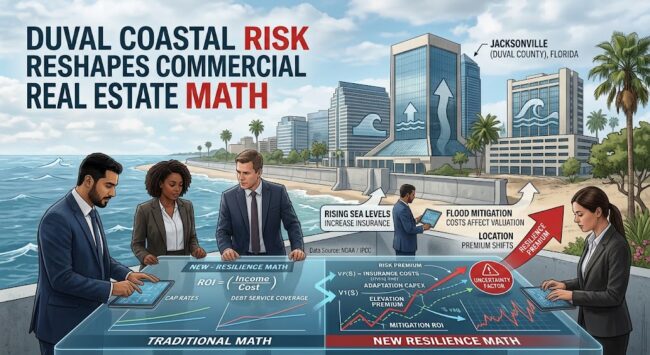
Commercial property insurance in Duval County is getting cheaper in 2026, but coastal and riverfront risk still drives underwriting, financing and value. Owners face a softening but fragile market, new rules pushing commercial policies out of Citizens, and flood exposure that city models say could triple without changes in development.
Key Takeaways
| Metric | Figure | Source |
|---|---|---|
| Commercial property rate change, Q2 2026 | -8.1% | The Baldwin Group |
| Consecutive quarters of property rate declines | 5 | The Baldwin Group |
| Florida surplus lines policies, first half 2026 | 982,627 (+15%) | Florida Surplus Lines Service Office |
| Citizens commercial clearinghouse deadline | Jan. 1, 2027 | SB 1028 (Ch. 2026-150) |
| Jacksonville shoreline miles | ~1,500 | City of Jacksonville / APA |
| Residents in flood-vulnerable areas, now vs. future if unchanged | ~140,000 to 430,000+ | Resilient Jacksonville Strategy |
| City commitment to McCoys Creek restoration | $105.4 million | Action News Jax via Hoodline |
Current Insurance Realities
Direct answer: Florida’s commercial property insurance market is in its softest stretch since 2020. Rates are falling, capacity has returned and reinsurance costs are down. But the relief is uneven. Coastal, habitational and older riverfront assets in Duval County still pay more and face tighter terms than inland, well-mitigated buildings.
A Market That Turned
For Jacksonville owners who lived through the 2022 and 2023 renewals, 2026 feels different. Tampa-based The Baldwin Group reported that commercial property pricing fell 8.1% in the second quarter of 2026, the fifth straight quarterly decline. That followed a 7.1% drop in the first quarter, and it comes after pricing peaked near 20% increases in early 2023.
Baldwin attributed the softening to abundant capacity and better reinsurance terms. Risk-adjusted global property catastrophe reinsurance pricing fell roughly 16% at mid-year 2026, after a 12% decline at the January renewal. Forecasters also called for a below-normal Atlantic hurricane season.
Florida’s reform package is part of the story. According to figures the Insurance Information Institute cited from a Florida Office of Insurance Regulation stability report, new property insurance lawsuit filings fell by half from the 2020 peak through the end of 2025. Triple-I also reported that 21 carriers have entered Florida since 2023.
The Surplus Lines Shift
Much of the new capacity for commercial property is arriving through the excess and surplus (E&S) market rather than traditional admitted insurers. Through June 30, 2026, Florida surplus lines carriers wrote 982,627 policies, up 15% from a year earlier, according to the Florida Surplus Lines Service Office. Commercial property is the largest and fastest-growing segment.
Brokers describe a market that swung from scarcity to oversupply quickly enough to push rates down. That is good news at renewal. It also carries a warning. Insurance Business noted that many newer carriers entered Florida thinly capitalized, and a major hurricane could force some of them out and reverse the pricing trend.
For Duval County owners, that means today’s quote is not a long-term cost assumption.
Two Markets, Not One
Broker commentary in 2026 describes a bifurcated Florida commercial market:
| Risk Profile | 2026 Experience |
|---|---|
| Inland, mitigated, non-habitational | Flat to falling rates, broader terms |
| Newer construction, elevated, strong roof | Competitive bidding, better deductibles |
| Coastal habitational (apartments, condos, hotels) | Tighter placement, often surplus lines |
| Older riverfront, pre-modern code | Higher premiums, named-storm deductible pressure |
A Southside flex industrial building and a 1970s riverfront apartment complex in the same county can have very different insurance stories in the same quarter.
Legislative Shifts: SB 1028 and the Citizens Clearinghouse
The most consequential 2026 law for Duval commercial owners is SB 1028, signed June 16, 2026 (Chapter 2026-150). It targets commercial residential and commercial nonresidential policies at Citizens Property Insurance Corp., the state’s insurer of last resort.
Key provisions:
- Citizens must create two commercial clearinghouses, one for admitted insurers and one for approved surplus lines insurers, operational by January 1, 2027.
- New and renewing commercial applications must route through those clearinghouses before Citizens can quote or bind.
- If an approved surplus lines carrier offers comparable coverage at a total cost no more than 15% above Citizens, the property generally becomes ineligible for Citizens.
- Participating surplus lines carriers must meet financial strength standards, and the Office of Insurance Regulation gained added authority to vet them.
The bill passed the Senate 33-1 and the House 88-19. Critics, including public radio coverage in Sarasota, argued it could push some condo and commercial owners into higher-priced, more lightly regulated coverage. Supporters see it as the final step in shrinking Citizens’ exposure, which fell below 300,000 total policies as of May 31, 2026.
What it means for Duval owners now on Citizens: Expect to see private offers in 2027, and expect some of them to cost more. Review policy forms carefully. Surplus lines rates and forms are not reviewed by the Office of Insurance Regulation the way admitted policies are, so “comparable” coverage deserves line-by-line attention.
Flood Is a Separate Problem
Standard commercial property policies generally exclude flood. The National Flood Insurance Program caps commercial coverage at $500,000 for buildings and $500,000 for contents, which is often far below replacement cost for mid-size and larger assets. Owners usually layer private flood or excess flood coverage on top.
Lenders care because properties in Special Flood Hazard Areas, zones beginning with A or V, generally must carry flood insurance when financed through federally regulated lenders. FEMA continues to issue map revisions for Duval County, including Letters of Map Revision published in the Federal Register in January 2026, so a property’s zone is not static.
Mapping Vulnerability
Direct answer: Duval County’s flood risk is not just coastal. Downtown, the riverfront neighborhoods, tributary corridors and the Beaches face different combinations of storm surge, river flooding, tidal backup and heavy rainfall. Jacksonville’s own compound flood models show risk extending well inland along the St. Johns River and its creeks.
A City Shaped by Water
Jacksonville is the largest city by area in the continental United States, with roughly 1,500 miles of shoreline along the Atlantic, the St. Johns River and its tributaries. That geography produces several overlapping flood types, which the city now models together as “compound” flooding: storm surge, river flow, tides and rainfall interacting at the same time.
The city’s Chief Resilience Officer, Anne Coglianese, has noted that properties set back from the river or coast can still flood during heavy rain events. For commercial real estate, that matters because underwriters and lenders increasingly look beyond the FEMA zone to modeled risk.
Risk Zones Investors Watch
| Area | Primary Exposure | What Owners Should Know |
|---|---|---|
| Downtown Northbank / Shipyards | River surge, tidal backup, aging bulkheads | Hurricane Irma set flooding records downtown in 2017 |
| Southbank | River flooding, storm surge | Major riverfront redevelopment raises the stakes |
| Riverside / San Marco | River and stormwater flooding | Neighborhoods long familiar with flooding |
| McCoys Creek / Mixontown | Tributary and rainfall flooding | City’s top flood priority in Local Mitigation Strategy |
| Jacksonville, Neptune, Atlantic Beaches | Storm surge, wind, erosion | Coastal map updates expanded at-risk streets |
| Mayport / Intracoastal corridor | Surge, tidal flooding | Port and military-adjacent industrial exposure |
Downtown and the Riverfront
Downtown Jacksonville is in the middle of its largest redevelopment push in decades, with riverfront projects on both the Northbank and Southbank. It is also where history offers the clearest warning. During Hurricane Irma in 2017, a downtown river gauge measured about three feet above flood stage, producing record flooding in the urban core.
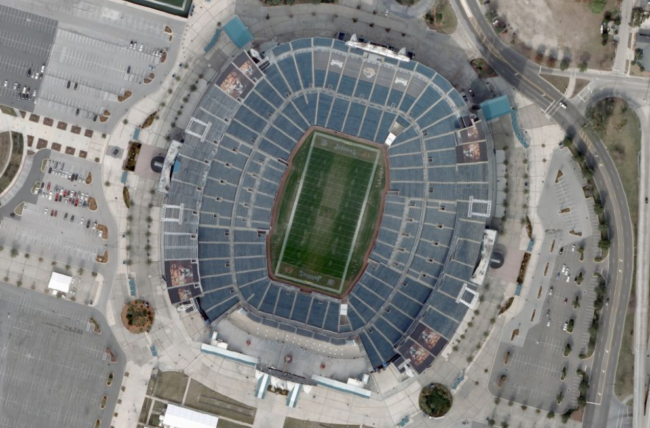
Earlier reporting by Action News Jax on the Shipyards area found that a study commissioned by the Jacksonville Jaguars described the stadium and Shipyards area as a coastal high hazard area, said bulkheads warranted replacement, and suggested the adopted flood maps understated vulnerability to major flood events. That finding is a reminder that the official FEMA zone is a floor for analysis, not a ceiling.
The Beaches
At the coast, wind and storm surge dominate. FEMA’s coastal map updates for Duval County showed significantly more Jacksonville Beach streets in higher-risk zones than earlier maps. For hospitality, retail and multifamily assets east of the Intracoastal, named-storm deductibles and wind coverage terms often matter as much as flood.
Tributaries and Inland Corridors
McCoys Creek illustrates the inland problem. Groundwork Jacksonville reports that the city’s stormwater plan identifies 26 local roads in the watershed that flood in a five-year storm, with 542 structures considered at risk. The creek is ranked the city’s top priority for flooding, storm surge and sea-level rise in its Local Mitigation Strategy.
The Growth Problem
The Resilient Jacksonville Strategy projects that if the city keeps developing the way it has, the number of residents living in flood-vulnerable areas could roughly triple, from nearly 140,000 today to more than 430,000. That projection is why the city is steering growth toward lower-risk areas, and why site selection decisions made now will shape insurability for decades.
The ROI of Resiliency
Direct answer: Resilience spending in Duval County is increasingly a financial decision, not just an engineering one. Public flood projects reduce area-wide risk, while private investments like elevation, flood barriers, roof upgrades and wind mitigation improve insurability, lower deductibles and make assets easier to finance and sell.
Public Infrastructure: What the City Is Building
Jacksonville launched the Resilient Jacksonville Strategy in October 2023 as a 50-year roadmap with 45 resilience actions covering policy, projects and programs. The plan won the American Planning Association’s 2024 National Planning Award for Resilience and Sustainability, and the city reported that 38 of the 45 actions were underway within the first year.
Notable elements for commercial owners include:
- Compound flood modeling that combines river, tidal and rainfall risk, giving the city better data for drainage and development decisions.
- Encouraging development in lower-risk areas, which may influence future land use and permitting.
- An action to improve Northeast Florida’s flood and property insurance markets, which signals local attention to insurability.
- McCoys Creek restoration, with $105.4 million committed by the city and $3 million plus technical support from NOAA Fisheries. The project is expected to deliver about two feet of flood reduction benefit and connect to the Emerald Trail network.
State Policy: SB 302 and Nature-Based Defenses
SB 302, the 2026 Coastal Resiliency law signed in March and effective July 1, 2026, directs the Florida Department of Environmental Protection to develop design guidelines and a statewide permitting process for nature-based and hybrid “green-gray” coastal protection by January 1, 2027. That includes living shorelines, mangroves, oyster reefs and wetlands, with permitting incentives tied to the Resilient Florida Grant Program.
For waterfront commercial owners along the St. Johns and the Intracoastal, this could eventually make living shoreline and hybrid bulkhead projects easier to permit than they are today.
Private Defenses That Pay Back
| Investment | Insurance Effect | Capital Effect |
|---|---|---|
| Elevation above base flood elevation | Lower flood premiums, better private flood options | Stronger lender appetite |
| Dry floodproofing and deployable barriers | Can reduce flood loss estimates | Protects tenant operations |
| Roof replacement to current code | Wind mitigation credits, better deductibles | Fewer inspection issues at sale |
| Impact-rated openings | Lower wind exposure | Helps habitational assets place coverage |
| Elevated mechanical and electrical systems | Reduces business interruption risk | Shortens recovery time |
| Bulkhead replacement or living shoreline | Reduces erosion and surge exposure | Addresses lender and buyer diligence flags |
The return on these investments shows up in several places: premiums, deductibles, the number of carriers willing to quote, loan terms, and exit value. In a soft market, the premium savings alone may look modest. The bigger payoff comes in the next hard market, when underwriters separate properties that can be insured from properties that cannot.
Building Codes and Lenders
Florida’s statewide building code, updated on a regular cycle, is among the strictest in the country for wind. Buildings constructed to newer code editions generally underwrite better than older stock. Jacksonville’s large inventory of older commercial buildings, particularly along the river, is where owners face the widest gap between today’s insurance pricing and what a post-storm market might demand.
Expert Forecast: Underwriting Trends Through the Late 2020s
Direct answer: Brokers and analysts expect continued modest softening in 2026 and into 2027 unless a major hurricane hits Florida. The longer-term drivers of underwriting for Duval commercial real estate are modeled flood risk, construction quality, carrier capitalization and how quickly Citizens shifts commercial risk into the private market.
Near Term: Softening With a Catch
Broker outlooks published this year generally describe the E&S property market as unlikely to re-harden broadly in 2026 absent a severe, capital-eroding catastrophe. Florida Senate President Ben Albritton said early in the 2026 session that he expected property insurers to keep reducing rates in coming months and years, along with continued scrutiny of rate requests.
Florida has also had a lucky run. Insurance Business reported this year that no hurricane made landfall in the state in 2025, and none had in 2026 as of its reporting. Underwriters know a single landfall can reset expectations quickly.
What to Watch Through 2029
| Factor | Direction | Why It Matters |
|---|---|---|
| Reinsurance pricing | Falling in 2026 | Primary rates follow reinsurance costs |
| Citizens commercial clearinghouse | Launches Jan. 2027 | Moves risk to private and surplus lines carriers |
| New carrier capitalization | Uneven | Thin carriers may exit after a major storm |
| Flood map revisions | Ongoing | Zone changes can trigger lender requirements |
| Modeled risk vs. FEMA maps | Gap widening | Underwriters price to models, not just zones |
| State resilience permitting | New standards by 2027 | Could lower cost of shoreline projects |
The Older Building Question
In 2021 testimony to a Jacksonville City Council special committee on resiliency, the board chair of the Flood Mitigation Industry Association warned that older buildings in Jacksonville would face large flood insurance increases over the following five to ten years. Federal flood pricing reforms since then have moved in that direction, and the gap between older and newer stock remains one of the clearest underwriting divides in the market.
Legal and Transaction Considerations
For acquisitions and refinancings in Duval County, flood and wind diligence now belong alongside environmental reports and title review. Practical steps:
- Confirm the current FEMA zone and any pending map changes or revisions affecting the parcel.
- Request loss runs and prior flood claim history from the seller.
- Obtain an elevation certificate for buildings in or near Special Flood Hazard Areas.
- Review named-storm and flood deductibles as a percentage of insured value, not just premium.
- Model insurance cost at hard-market levels, not just today’s quote.
- For Citizens-insured assets, plan for clearinghouse offers starting in 2027.
Brian’s Take
In my money management years, the most expensive mistake was treating a cyclical low as the new normal. Florida commercial property insurance is in a cyclical low right now. Rates have fallen for five straight quarters, capital has flooded back in, and the state hasn’t taken a hurricane landfall in a while. Every one of those conditions can reverse in a single storm.
For Duval County owners and investors, that argues for a simple discipline: underwrite deals at hard-market insurance costs, and treat today’s savings as a bonus to bank, not a reason to stretch on price. The other lesson is that location inside Jacksonville matters more than the word “Jacksonville.” A mitigated industrial building on high ground and an older riverfront asset are in different insurance markets even when they share a ZIP code.
The good news is that this cycle gives owners a window. Lower premiums free up cash. The smartest use of that cash is resilience work, such as roofs, elevation and shoreline upgrades, that will matter most when the market turns.
Frequently Asked Questions
Are commercial property insurance rates falling in Jacksonville?
Yes, broadly. Florida commercial property rates have declined for five consecutive quarters, with an 8.1% drop in the second quarter of 2026 according to The Baldwin Group. Coastal, habitational and older riverfront properties see less relief than inland, well-mitigated buildings.
What does SB 1028 mean for commercial properties insured by Citizens?
Starting January 1, 2027, new and renewing commercial policies must go through clearinghouses before Citizens can write them. If an approved surplus lines carrier offers comparable coverage costing no more than 15% above Citizens, the property generally loses Citizens eligibility.
Does commercial property insurance cover flood damage?
Generally no. Flood requires separate coverage. NFIP commercial policies cap building coverage at $500,000 and contents at $500,000, so larger properties often add private or excess flood insurance.
Which parts of Duval County face the highest flood risk?
Risk is concentrated along the St. Johns River and its tributaries, including Downtown, the Shipyards area, Riverside, San Marco and the McCoys Creek watershed, as well as the Beaches and the Intracoastal corridor. Heavy rainfall can also flood properties away from the water.
What is the Resilient Jacksonville Strategy?
It is the city’s 50-year resilience roadmap, launched in 2023, with 45 actions addressing flooding, heat and other risks. It includes compound flood modeling, guidance on development in lower-risk areas, and infrastructure projects like the McCoys Creek restoration.
Will Florida insurance rates go back up?
A major hurricane landfall could reverse the current softening, especially if thinly capitalized carriers exit. Brokers generally expect continued modest declines or a plateau without a major catastrophe.
What resilience upgrades help most with insurance?
Roof replacements to current code, impact-rated openings, elevation above base flood elevation, elevated mechanical systems and flood barriers typically improve insurability. Benefits include lower premiums, better deductibles, more carrier options and stronger lender appetite.
Sources and Further Reading
- The Baldwin Group, quarterly insurance market report, Q2 2026 (reported by Business Insurance)
- Insurance Business, “Florida’s surplus lines market is booming as prices fall” (2026)
- Florida Surplus Lines Service Office, policy data through June 30, 2026
- WWSB / Insurance Information Institute, Florida property insurance market update (August 31, 2026)
- News4Jax / News Service of Florida, “DeSantis signs bill to push more commercial policies out of Citizens” (June 17, 2026)
- ResourcePro, summary of Florida SB 1028 (Chapter 2026-150)
- The Capitolist, “DeSantis Signs Bill Tightening Citizens Coverage for Commercial Properties” (June 17, 2026)
- WSLR, coverage of SB 1028 signing (June 18, 2026)
- Insurance Journal, Florida Senate President Albritton on 2026 insurance legislation (February 5, 2026)
- The Nature Conservancy, CS/CS/SB 302 Coastal Resiliency briefing (June 2026)
- Florida Department of Environmental Protection, SB 302 signing announcement (March 19, 2026)
- City of Jacksonville, Resilient Jacksonville Strategy and Office of Resilience materials
- Halff, “Resilient Jacksonville Plan Earns APA National Honor” (October 24, 2024)
- WOKV / Action News Jax, Jacksonville resiliency strategy flood projections
- Hoodline, “McCoy’s Creek Restoration Aims to Address Jacksonville Flooding” (October 8, 2026)
- Action News Jax, investigation of Shipyards area flood risk
- Jacksonville Today, findings of the City Council special committee on resiliency (March 23, 2021)
About the Author