April 28, 2026
For decades, Jacksonville carried a nickname that locals tried to laugh off but secretly winced at: “The City of Renderings.” It was a jab at Jacksonville’s reputation for endlessly unveiling flashy development plans — glossy brochures, beautiful CGI flyovers, ambitious press conferences — that quietly never got built.
Empty lots stayed empty. Vacant downtown buildings stayed vacant. The Jacksonville Landing sat decaying on the Northbank for years before being demolished. The Shipyards site languished. Promises came and went.
Then something shifted.
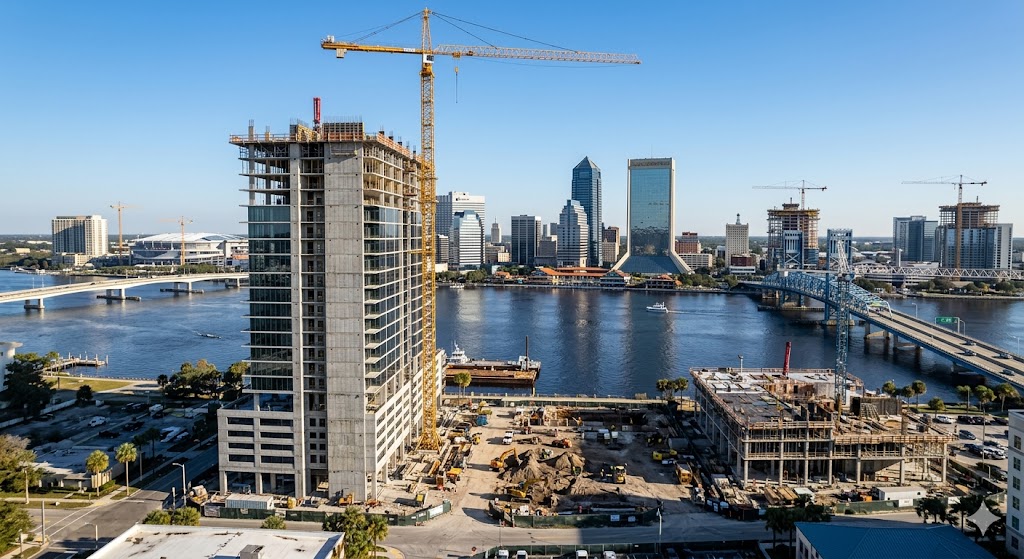
Around 2022, the cranes started showing up. By 2024, downtown Jacksonville had a skyline visibly under construction. By 2026, the numbers tell a story almost nobody would have predicted a decade ago: more than $4 billion in active construction, an additional $6.5 billion in active development pipeline projects, and individual mega-projects like Shad Khan’s $1.4 billion Jaguars “Stadium of the Future” renovation, the $2 billion Pearl Square / Gateway Jacksonville mixed-use district, the $693 million RiversEdge Southbank development, the $287.5 million University of Florida graduate campus in LaVilla, the Four Seasons Hotel & Private Residences rising on the Northbank, the One Riverside Avenue project anchored by Whole Foods, the Riverfront Plaza park reborn from the ashes of the Jacksonville Landing, and dozens more.
Jacksonville isn’t a city of renderings anymore. It’s a city of bricks and beams and bulkheads — a Florida boomtown coming into its own at exactly the moment the rest of the country starts paying attention.
But here’s the part that almost never makes the front page: none of this construction is happening because of cranes alone. Behind every shovel turning dirt across Duval County is an unsexy financial instrument that quietly determines whether the project actually gets finished. It’s called a construction bond, and it is, without exaggeration, the single biggest reason Jacksonville’s “City of Renderings” reputation is finally dying.
Let’s break down why.
Construction Bonds 101: The Promise Behind the Promise
A construction bond, also called a surety bond or contract bond, is a three-party financial guarantee designed to make sure construction projects actually get built. The three parties are:
- The Principal — the contractor performing the work.
- The Obligee — the project owner who requires the bond. In Jacksonville, this is often the City of Jacksonville, Duval County, the Jacksonville Transportation Authority, the Duval County Public Schools, JAXPORT, the State of Florida, or a private developer or construction lender.
- The Surety — the bonding company that financially backs the contractor’s promise to perform.
If the contractor fails — meaning they walk off the job, file bankruptcy, do shoddy work, fail to pay their subs, or otherwise blow it — the surety steps in. They either pay damages, hire a replacement contractor, finance the project to completion, or some combination thereof. Maximum exposure is capped at the bond amount, which on Florida public works projects is typically 100% of the contract price.
Pop the hood on that arrangement and the importance becomes obvious. The construction bond is the reason Jacksonville’s mega-projects don’t end up like the Jacksonville Landing — half-built, abandoned, and haunted by what could have been.
The Four Bonds Every Jacksonville Builder Should Know
In Northeast Florida construction, four bond types do most of the work:
- Bid Bonds. Submitted alongside a contractor’s bid. Guarantees that if the contractor wins, they’ll actually sign the contract and provide the required performance and payment bonds — instead of submitting an artificially low bid, winning the project, and walking away when reality bites. This is why bid bonds are mandatory on virtually every Jacksonville public works competition.
- Performance Bonds. Guarantees the contractor will complete the work according to specs, on time, and to required quality. If they don’t perform, the surety either gets it done or pays the owner the difference.
- Payment Bonds. Guarantees that subcontractors, laborers, and material suppliers will get paid even if the prime contractor fails them. This is the bond that protects the small Jacksonville businesses pouring concrete, hanging drywall, and supplying steel on the city’s biggest jobs.
- Maintenance Bonds. Cover defects and warranty obligations after a project is finished, typically for one to two years post-completion. Critical on infrastructure work where issues sometimes only surface months later.
In a city where individual projects routinely exceed nine figures and where one stalled tower can ripple losses through hundreds of subcontractors, all four bond types are everyday tools.
Brian’s Take: Jacksonville’s Building Boom Is the Most Underrated Story in Florida Real Estate.
While Miami soaks up all the headlines and Tampa gets the relocation press, Jacksonville is quietly putting more shovels in the ground per capita than either of them — and doing it with a discipline that comes from finally shaking off twenty years of “almost” promises. The contractors and developers winning right now in Jacksonville are the ones who treated the bonding process as a credibility credential, not a hoop to jump through.
— Brian
The Florida Legal Backbone Behind Every Jacksonville Project
Jacksonville’s $11 billion-plus pipeline doesn’t run on goodwill. It runs on a tightly defined legal framework that requires bonds on virtually every meaningful public project — and on most major private ones.
Section 255.05: Florida’s Little Miller Act
The cornerstone of Florida public bonding is Section 255.05 of the Florida Statutes, commonly known as Florida’s Little Miller Act. It mirrors the Federal Miller Act (40 U.S.C. § 3131), which governs federal contracts of $100,000 or more.
For state and local public projects in Jacksonville, Section 255.05 lays out the rules clearly:
- Public contracts of $100,000 or less may be exempt from bonding entirely.
- Contracts between $100,000 and $200,000 — the public agency may waive bonding at its discretion.
- Contracts of $200,000 or more — payment and performance bonds are required, generally in an amount equal to 100% of the contract price.
- Counties and municipalities can elect to waive bonding on contracts of $200,000 or less, though most major Jacksonville agencies require bonding regardless.
When you factor in that the City of Jacksonville’s Capital Improvement Plan alone runs hundreds of millions per year — and that combined Duval County, JTA, JAXPORT, JEA, and Duval County Public Schools construction spending lands in the billions — you can see why Section 255.05 is essentially the financial constitution of Jacksonville’s growth story.
Section 337.18: FDOT and Transportation Bonds
Florida transportation projects operate under their own bonding regime via Section 337.18 of the Florida Statutes. The framework:
- A surety bond is required of the successful bidder in an amount equal to the awarded contract price.
- FDOT may waive bonding for non-critical contracts of $250,000 or less.
- For mega-projects of $250 million or more, FDOT can use a hybrid approach combining surety bonds with alternative security like letters of credit, U.S. bonds and notes, parent company guarantees, or cash collateral.
Jacksonville sees a steady drumbeat of FDOT-bonded work: I-95 modernizations, I-295 beltway expansions, the long-running First Coast Expressway extension, the Hart Bridge “Off-Ramp” Removal project, and the regional public transit upgrades coordinated through the Jacksonville Transportation Authority. Every single one of those projects required contractors to sit across from a surety underwriter and prove they could be trusted with public transportation dollars.
Chapter 713: Florida’s Construction Lien Law for Private Projects
Public projects aren’t the only bonded work in Jacksonville. Chapter 713 of the Florida Statutes — Florida’s Construction Lien Law — also creates bonding tools for private projects:
- Section 713.23 lets private developers use a payment bond as an alternative to facing potential lien claims from subcontractors and suppliers. For Jacksonville’s luxury private developers — the Four Seasons project, the high-rise condominiums planned for the Sports & Entertainment District, the major mixed-use builds in Brooklyn and the Southbank — payment bonds are how owners keep clean title and keep construction lenders comfortable.
- Section 713.245 authorizes “Conditional Payment Bonds” with specific protections.
The combination of public-sector statutes and private-sector lien law tools creates a comprehensive bonding ecosystem that touches almost every meaningful construction dollar in Northeast Florida.
The Real Mechanics: How Bonds Translate Renderings Into Reality
Now let’s connect the legal framework to what’s literally happening across Jacksonville right now.
Bonds Pre-Qualify Every Major Contractor in Northeast Florida
Before a surety company will issue a bond on a Jacksonville project, they conduct rigorous underwriting: CPA-prepared financial statements, work-in-progress reports, project history, ownership structure, banking relationships, subcontractor depth, personal indemnity from principals. The surety effectively functions as a financial gatekeeper, screening out contractors who aren’t structurally ready to deliver.
In a city that has historically been burned by overpromised, underdelivered projects, this gatekeeping is enormous. The reason Jacksonville’s current construction pipeline is actually being built rather than perpetually announced is that the surety underwriting layer has gotten serious about the contractors it backs. Marginal players don’t get the bonds. Without bonds, they don’t get the projects. Without the projects, they can’t keep promising things they can’t deliver.
The bonding industry, quietly, has been one of the biggest contributors to Jacksonville finally shedding its “City of Renderings” identity.
Bonds Protect Public Funds in Duval County
When the City of Jacksonville commits public dollars to a Riverfront Plaza park rebuild, a Music Heritage Garden, the McCoys Creek restoration, fire station replacements, library renovations, road resurfacing, or the dozens of other projects in the active Capital Improvement Plan, construction bonds are how taxpayer money doesn’t get vaporized. If the contractor fails, the surety pays — not the citizens of Duval County.
Across the United States, surety companies have collectively paid billions of dollars over the decades on bonded projects where contractors failed. Without bonding, every one of those losses would have hit project owners — and ultimately taxpayers — directly. In a high-volume building market like Jacksonville’s, the insurance value of the bonding system is enormous and largely invisible to the public.
Bonds Protect Jacksonville’s Subcontractor Backbone
Walk onto any active Jacksonville job site — the Pearl Square block at North Pearl Street, the Block N11 building rising in the historic core, the Stadium of the Future demolition zone at EverBank, the Union Terminal Warehouse adaptive reuse on East Union Street — and you’ll see who actually builds Jacksonville: framing crews, electricians, plumbers, drywallers, glaziers, ironworkers, mechanical contractors, and material suppliers. The vast majority are family-owned, Northeast Florida-based small businesses with thin margins and limited cash reserves.
Without payment bonds, when a prime contractor goes bankrupt or simply refuses to pay, those subcontractors and suppliers can lose tens or hundreds of thousands of dollars overnight — often enough to put them out of business permanently. Payment bonds change that math entirely. A subcontractor on a bonded Jacksonville project knows they have legal recourse against the surety, provided they file the proper notices within Florida Statute 255.05’s strict deadlines.
Bonds Make Jacksonville’s Construction Lending Possible
Here’s the part most casual observers miss: the cranes you see across Jacksonville aren’t there because developers are writing personal checks. They’re there because banks, life insurance companies, and capital partners are issuing massive construction loans — and lenders financing nine and ten-figure projects do not fund unbonded work.
A lender backing the $254.3 million vertical construction of the Four Seasons Hotel & Private Residences on the Northbank needs to know the contractor can’t disappear mid-build, leaving the loan upside-down and the project a half-finished embarrassment on the riverfront. The bond is part of what makes the loan possible. No bond, no loan. No loan, no project. No project, no skyline.
That’s the cascade Jacksonville needs to understand. The bond makes the loan. The loan makes the project. The project makes the city.
Brian’s Take: Jacksonville’s Bonding Industry Is Quietly Why “The City of Renderings” Finally Started Getting Built.
The reason this current Jacksonville construction wave is actually delivering — instead of dying in announcement form like the past twenty years of grand plans — is that the contractors getting the work right now have all passed real surety underwriting scrutiny, which weeded out the dreamers and left only the deliverers. If you’re a Jacksonville business owner, supplier, or investor watching this boom, that quiet quality filter is one of the biggest reasons you can finally trust that what’s promised will get built.
— Brian
Real Jacksonville Projects That Couldn’t Exist Without Construction Bonds
Let’s get specific about the headline developments reshaping Jacksonville right now:
- Jaguars “Stadium of the Future.” Shad Khan’s $1.4 billion EverBank Stadium overhaul, including a massive roof canopy, open concourses, and enhanced fan experience. Targeted for completion in August 2028. The Jaguars will play at reduced capacity in 2025 and 2026 before relocating to Orlando or Gainesville for 2027. Bonded prime contractors required at every level.
- Four Seasons Hotel & Private Residences (Northbank). Backed by Khan’s Iguana Investments, the 10-story luxury hotel and residences project. Combined vertical construction cost of $254.3 million, growing to nearly $260 million with marina support work.
- One Shipyards Place. Six-story office building from Iguana Investments across Gator Bowl Boulevard from EverBank Stadium. Topped off January 17, 2025, with completion expected first quarter 2026.
- Pearl Square / Gateway Jax Master Plan. A multi-phase $2 billion mixed-use development covering five blocks in Downtown’s NorthCore district, with the $419 million Pearl Street District as the centerpiece. Will deliver more than 1,000 residential units and the Northbank’s first Publix grocery store. First phase opens in 2026.
- Block N11. Gateway Jax’s first project — a seven-story mixed-use building at 515 North Pearl Street, bordered by Pearl, Julia, Ashley, and Church streets. 205 apartments and 24,086 square feet of retail, commercial, and storage space.
- RiversEdge: Life on the St. Johns. A $693 million mixed-use development on the former JEA Southside Generating Station site on the Southbank. More than 950 residential units, four parks (now open as of November 2024), and a central riverfront park. Toll Brothers began vertical townhome construction in 2024.
- One Riverside Avenue. Mixed-use community anchored by Whole Foods Market, with more than 390 apartments and 39,000 square feet of riverfront retail.
- Riverfront Plaza. The transformation of the demolished Jacksonville Landing site into a signature waterfront park. Phase 1 cost $32.5 million to $38 million, with soft opening November 2024. Phase 2, budgeted at $46 million, breaks ground by end of 2025.
- Music Heritage Garden. A $6 million Northbank park stretching from Water to Hogan streets along the Jacksonville Center for the Performing Arts. Walkways shaped like musical notes, playable recordings, and a Walk of Fame dedicated to local musicians. Completion expected spring 2026.
- Shipyards West Park. A $74.7 million, 10-acre park planned between Catherine Street and Hogans Creek on the Northbank, featuring a two-story gallery and event pavilion, a beach, a cove with pedal boats, a fishing pier, and a multipurpose lawn.
- University of Florida Graduate Campus in LaVilla. A $287.5 million initial-phase higher-ed mega-project. UF selected Edgemoor Infrastructure & Real Estate as the preferred developer, with Clark Construction and Auld & White Constructors as core construction partners alongside HOK and OJB Landscape Architecture. Initial programs open in 2026, with new construction following as the campus expands.
- McCoys Creek Restoration. A $107.6 million environmental and recreational project bringing the creek back into daylight and creating new public space along its banks.
- Union Terminal Warehouse. A $73 million adaptive reuse of a 1913 historic warehouse at 700 East Union Street, near the Eastside and EverBank Stadium. Atlanta-based Columbia Ventures spent more than six years bringing the 361,169-square-foot building back to life. Reopened March 6, 2024.
- Decca Live. A $3.31 million music and dance venue renovation at 323 East Bay Street.
- Stadium of the Future-adjacent district. Anchoring an entertainment district with Jaguars headquarters, luxury hotels, and public spaces around EverBank.
- Florida Semiconductor Institute. A major educational anchor coming to downtown Jacksonville alongside the UF graduate campus, aligning with Jacksonville’s “eds and meds” strategy.
Multiply that headline list by the dozens of additional active projects across Brooklyn, LaVilla, Springfield, Riverside, San Marco, the Beaches, the Northside, Southside, Mandarin, Arlington, the Westside, and the rapidly growing Nocatee corridor, and you start to grasp the full scope of bonded construction shaping Northeast Florida’s future.
What It Costs to Bond a Jacksonville Project
For contractors trying to expand into the Jacksonville market — and there are a lot of them right now, with national firms relocating to chase the boom — here’s the practical math:
- Bond premiums typically run 1% to 3% of the bond amount for contractors with strong financials, solid credit, and meaningful project history.
- Higher-risk situations can run 3% to 15% — for newer contractors, weaker balance sheets, lower credit scores, or specialty/high-risk project types.
- Very large projects sometimes run below 1% as economies of scale and creditworthy underwriting kick in.
For a contractor bidding on a $20 million bonded Jacksonville public project, the bond premium might run anywhere from $200,000 to $600,000. A real cost — but one that gets baked into the bid and ultimately enables the contractor to compete for projects that would be inaccessible without bonding.
What Jacksonville-Focused Sureties Want to See
Sureties evaluating contractors for Jacksonville work typically require:
- Audited or CPA-reviewed financial statements for the most recent 2-3 fiscal years.
- Work-in-progress reports showing current commitments and capacity utilization.
- Bank reference letters demonstrating credit relationships and lines of credit.
- Personal financial statements from owners for personal indemnity.
- Resume of completed projects at the size and complexity of the target work.
- Organizational documents including operating agreements and key personnel bios.
- References from past project owners and other sureties.
Stronger financials and project history equal higher aggregate bonding capacity — and bigger Jacksonville projects you can pursue. In a market where individual projects regularly exceed $50 million, your bonding capacity directly determines your competitive ceiling.
Brian’s Take: The Contractors Cleaning Up in Jacksonville Right Now Built Their Surety Relationships Years Before the Boom Started.
The contractors winning the biggest pieces of Jacksonville’s $11 billion pipeline aren’t the loudest ones, they’re the ones who spent the last decade quietly building rock-solid financial statements and surety relationships so they could move when the market finally turned. If you’re running a Jacksonville construction business and you’re not investing in your bonding capacity right now, you’re effectively choosing to watch the boom from the sidelines.
— Brian
The Bond Claims Process in Jacksonville: When Things Go Sideways
Construction bonds aren’t theoretical. They get used. Here’s how a typical bond claim plays out on a Jacksonville project:
- A default occurs. The contractor walks off, files bankruptcy, fails to pay subs, or delivers defective work that the owner formally rejects.
- The owner declares default, gives proper notice to both contractor and surety, and terminates the contractor’s right to complete the work.
- The surety investigates — verifying the default’s legitimacy, examining the contractor’s defenses, calculating real cost-of-completion, and assessing total exposure.
- The surety chooses a remedy — financing the original contractor to finish, hiring a replacement contractor and paying the cost difference, negotiating a buy-out with the owner, or paying damages up to the bond limit.
- The surety pursues the principal under the indemnity agreement — virtually every Jacksonville contractor has signed personal and corporate indemnity making them ultimately liable to the surety for any loss.
Florida Statute 255.05 strictly governs subcontractor and supplier claims on payment bonds for public projects. Subcontractors without a direct contract with the prime must serve a Notice to Contractor within 45 days of starting work, and a Notice of Nonpayment must typically be served within 90 days after the last furnishing of labor or materials. Missing these deadlines can void an otherwise valid claim. Every smart Jacksonville subcontractor has a Florida construction attorney on speed dial precisely because of these unforgiving timelines.
What Every Jacksonville Stakeholder Needs to Take Away
Construction bonds aren’t a peripheral detail of Jacksonville’s growth story. They are the financial backbone holding it all up. Every developer, contractor, subcontractor, supplier, investor, lender, and taxpayer in Northeast Florida has a stake in understanding them.
For developers: bonding lets you finance, build, and protect your investment.
For contractors: bonding capacity directly determines how big your projects — and your business — can grow.
For subcontractors and suppliers: payment bonds are your insurance policy when the prime contractor fails.
For lenders and capital partners: bonded projects are dramatically safer bets than unbonded ones.
For Duval County taxpayers: every public dollar invested in Jacksonville infrastructure is protected by a surety guarantee.
The towers rising over the Northbank, the Stadium of the Future taking shape at EverBank, the parks reclaiming the downtown waterfront, the UF graduate campus anchoring LaVilla, the Pearl Square neighborhood being built block by block, the historic warehouses coming back to life — every single one of them is supported by a quiet, unsexy network of bonding companies, surety underwriters, and construction-finance professionals who never get the credit but always carry the risk.
The next time you drive across the Acosta Bridge and look out at downtown Jacksonville’s emerging skyline, remember what’s actually making it all stand. Without construction bonds, the Stadium of the Future is a stadium of the maybe. Without construction bonds, Pearl Square is a vacant block. Without construction bonds, RiversEdge is a power plant ruin. Without construction bonds, the UF graduate campus is just another rendering on a wall.
With them, Jacksonville is finally — definitively — putting “The City of Renderings” reputation in the rear-view mirror.
That’s the unglamorous, undersung financial story behind Northeast Florida’s most important growth chapter in a generation.
Bond by bond, project by project, the new Jacksonville is being built for real.
Resources & Further Reading
- Florida Surety Association: 10 Things About Surety Bonds — State-level overview of how surety bonds work in Florida construction.
- Florida Statute 255.05 (Florida’s Little Miller Act) — The full text of Florida’s primary public works bonding statute, mandatory reading for anyone working on bonded Jacksonville projects.
- Florida Statute 337.18 (FDOT Bond Requirements) — Governs surety bonds on Florida transportation projects, including major Jacksonville and Duval County infrastructure.
- City of Jacksonville Capital Improvement Plan — Active list of Jacksonville’s bonded public construction projects across the city.
- Downtown Investment Authority of Jacksonville — Tracks the projects, incentives, and master plan reshaping downtown Jacksonville’s $6.5 billion development pipeline.
About the Author