April 27, 2026
Jacksonville, Florida: The World-Class Shipping and Logistics Hub Hiding in Plain Sight
If you live anywhere in Florida and you’ve ever opened a package, started a car, sipped a Puerto Rican coffee, eaten a banana from Honduras, or watched your kid unwrap a Toyota toy car on Christmas morning, there’s a very good chance Jacksonville touched it first.
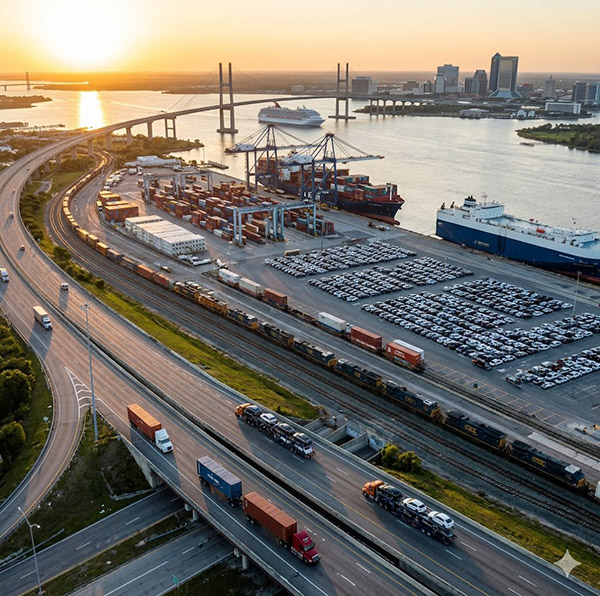
Most Floridians associate Jacksonville with the Jaguars, the beaches, the cooler-than-Miami winters, and that 30-minute stretch of I-95 where everyone collectively decides to drive 95 miles per hour. But quietly — and very deliberately — Jacksonville has been turning itself into one of the most important shipping and logistics hubs in the entire Western Hemisphere.
This isn’t hometown cheerleading. The numbers are absurd:
- JAXPORT moves 10+ million tons of cargo annually.
- Cargo through the port supports 258,800 jobs and generates roughly $44 billion in annual economic impact.
- It’s the #1 U.S. port for trade with Puerto Rico.
- It’s one of the top vehicle-handling ports in the entire country.
- It’s a one-day truck drive from 98 million U.S. consumers.
And that’s just the port. Layer on the rail lines, the trucking infrastructure, the Fortune 500 logistics headquarters, and the warehouse-fueled real estate boom, and you start to see why Jacksonville is increasingly being called “America’s Logistics Center.”
Let’s pull back the curtain on what’s actually happening up here, why it matters for every business in Florida, and meet the major players that make it all run.
Why Geography Made Jacksonville Inevitable
You can’t talk about Jacksonville’s logistics dominance without first talking about the unfair geographic hand it was dealt.
Jacksonville sits at a once-in-a-continent intersection:
- Three major interstates converge here — I-95 running up and down the East Coast, I-10 running coast-to-coast, and I-75 plunging straight into central and south Florida.
- Three Class I railroads meet inside the city — CSX, Norfolk Southern, and the Florida East Coast Railway (FEC) — which is a configuration almost no other Southeastern city can match.
- A 47-foot deepwater shipping channel on the St. Johns River with two-way traffic, meaning massive container ships can pass each other coming and going.
- An ocean port less than 10 nautical miles from the open Atlantic, but located on a sheltered river — the best of both worlds.
- One-day truck drive access to nearly a third of the entire U.S. population.
Translation: if you want to move cargo into the booming Southeast and the entire Florida peninsula efficiently, Jacksonville is geographically the best answer. Period.
This is why JAXPORT runs marketing materials with the tagline “X marks the spot” — and they’re not exaggerating. Independent shipping cost studies have repeatedly shown shippers can save 15% or more on the total landed cost of a 40-foot container shipped from Asia to Orlando when they route through Jacksonville instead of out-of-state ports like Savannah or Charleston. That’s the kind of savings that, multiplied by thousands of containers a year, becomes life-changing for a company.
A Quick Snapshot of JAXPORT’s Three Marine Terminals
JAXPORT itself is actually a system of three major terminals:
- Blount Island Marine Terminal — The crown jewel. The largest container facility, also handling roll-on/roll-off vehicle traffic, breakbulk, and heavy lift cargo. The U.S. Marine Corps even uses 1,100 acres for its Maritime Prepositioning Force operations.
- Talleyrand Marine Terminal — The oldest of the three, handling vehicles, liquid bulk, breakbulk and containers, plus refrigerated cargo capabilities.
- Dames Point Marine Terminal — The newest, anchored by the TraPac Container Terminal serving Mitsui O.S.K. Lines, plus an Intermodal Container Transfer Facility that cuts drayage distances from 19 miles down to under 3 miles.
In FY 2025, JAXPORT moved nearly 1.4 million TEUs (containers), 506,000 vehicle units, and more than 10 million tons of total cargo. And the port is still actively expanding — with a $250 million Blount Island modernization recently completed and an air-draft increase to 205 feet on track for end of 2026, which will allow ultra-large container vessels to call directly.
Brian’s Take: Jacksonville’s Logistics Story Is the Quietest Florida Real Estate Boom Nobody Is Talking About.
The smart money in commercial real estate isn’t chasing condos in Brickell anymore — it’s buying warehouse space along Pritchard Road in Jacksonville, where rents have doubled in five years because every Amazon, FedEx, and Wayfair in the country wants a building within 30 minutes of JAXPORT. If you’re a Florida investor or business owner ignoring this trend, you’re missing the most durable, infrastructure-backed growth story in the state.
— Brian
The 2026 Game-Changer: New Asia-Jacksonville Direct Service
Until very recently, most Asian cargo coming into the Southeast U.S. landed in Savannah or Charleston, then either trucked or railed down to Florida. Jacksonville got the leftovers.
That’s about to flip.
In April 2026, the global shipping alliance Ocean Alliance — made up of CMA CGM, COSCO, OOCL, and Evergreen Marine — introduced a new weekly direct service called the Chesapeake Bay Express (CBX). It’s a major deal. The service connects:
- Vung Tau, Vietnam → Yantian, China → Shanghai → Busan, South Korea → Kobe, Japan
- through the Panama Canal
- to Norfolk → Charleston → Savannah → and finally Jacksonville
- before returning to Vietnam.
Jacksonville being the final U.S. port of call is significant. It means Jacksonville becomes the natural “load up the empties and turn it around” hub, which positions the city as a key East Coast equipment repositioning center and gives U.S. exporters here some of the fastest transit times to Asia anywhere on the East Coast.
When the air-draft project finishes at the end of 2026, allowing those ultra-large container ships full unrestricted access to Blount Island, expect this service to expand and additional Asia-direct routes to follow. Jacksonville’s days as a “secondary” East Coast port are officially over.
The Hidden Trade Lifeline: Puerto Rico
Here’s a fact that surprises almost everyone outside the industry: Jacksonville is the #1 U.S. port for trade with Puerto Rico. Not Miami. Not New York. Jacksonville.
When you walk into a grocery store in San Juan and grab a box of cereal, a bottle of laundry detergent, or a Goya can — there’s an excellent chance that product passed through Jacksonville first. JAXPORT imported 649,658 metric tons from Puerto Rico in fiscal year 2025, with comparable volumes flowing the opposite direction.
Two of the three largest Puerto Rico-focused shipping companies in America — Crowley Maritime and Trailer Bridge — are headquartered in Jacksonville. TOTE Maritime Puerto Rico also runs its operations here. In a very real sense, the supply chain that keeps Puerto Rico fed, clothed, and supplied with consumer goods runs almost entirely through Jacksonville.
After Hurricane Maria devastated Puerto Rico in 2017, Jacksonville became the launching point for federal aid, supplies, and rebuilding materials. The city quite literally helped save the island. That relationship has only deepened in the years since.
Cruise, Auto, and the Rest of the Cargo Story
JAXPORT isn’t a one-trick container port. The diversification is what makes it bulletproof against any single industry downturn:
- Vehicle Handling: Jacksonville is one of the top two or three vehicle-handling ports in the entire United States. In FY2025, 506,000 vehicle units moved through the port. Southeast Toyota Distributors runs a state-of-the-art vehicle processing facility on Blount Island.
- Cruise: Norwegian Cruise Line added Jacksonville to its lineup, helping the port move over 200,000 cruise passengers in the past year. That cruise traffic supports a growing tourism economy that didn’t really exist here a decade ago.
- Liquid Bulk and Breakbulk: Petroleum, chemicals, gypsum, paper products, and heavy machinery all flow through JAXPORT in significant volumes.
- Cement and Aggregates: Cemex maintains a major footprint, supplying construction materials across the Southeast.
This diversification is the not-so-secret reason JAXPORT keeps growing even when global trade hiccups. When containers slow down, vehicles speed up. When cruise dips, breakbulk picks up. Diversification is durability.
Brian’s Take: The Best Florida Businesses Aren’t Just Selling to Jacksonville — They’re Selling to Everyone Who Routes Through Jacksonville.
If you’re a B2B service provider — accounting, marketing, HR, legal, IT — pitching the trucking, warehousing, and logistics tenants stacking up around JAXPORT is the single highest-velocity B2B lane in Florida right now. These companies are growing at double-digit rates, they’re relocating from out-of-state, and they need vendors who actually understand their world.
— Brian
The Major Logistics Companies Calling Jacksonville Home
Here’s where things get really interesting. A surprising number of the biggest names in American transportation and logistics are headquartered or anchored in Jacksonville. If you ever wonder why so much corporate real estate is being absorbed in this market, these are the tenants doing the absorbing.
CSX Corporation
Address: 500 Water Street, 15th Floor, Jacksonville, FL 32202 Phone: (904) 359-3200 What they do: A Fortune 500 Class I railroad operating one of the largest rail networks in eastern North America. CSX moves freight to nearly two-thirds of the nation’s population. Jacksonville is its corporate headquarters.
Crowley Maritime Corporation
Corporate Office: 9487 Regency Square Blvd., Jacksonville, FL 32225 Main Port Office: 2831 Talleyrand Ave., Jacksonville, FL 32206 Phone: (904) 727-2200 What they do: A privately held, U.S.-owned shipping, logistics, and energy company founded in 1892. Crowley operates more than 200 vessels worldwide and is one of the largest carriers serving Puerto Rico, the Caribbean, and Central America.
Landstar System, Inc.
Address: 13410 Sutton Park Drive South, Jacksonville, FL 32224 Phone: (904) 398-9400 (toll-free: 800-872-9400) What they do: A publicly traded Fortune 500 transportation services company specializing in third-party logistics. Landstar operates an asset-light network of 8,800+ owner-operators, 1,000+ independent freight agents, and 70,000+ vetted carriers.
Trailer Bridge, Inc.
Address: 10405 Eastport Rd., Jacksonville, FL 32218 Phone: (904) 751-7100 (toll-free: 800-554-1589) What they do: Major ocean freight carrier specializing in Puerto Rico, Dominican Republic, Caribbean, and U.S. Virgin Islands service, plus full-service domestic logistics, trucking, and intermodal solutions.
TOTE Group / TOTE Maritime
Address: 9501 Eastport Rd., Jacksonville, FL 32218 Phone: (904) 855-1260 What they do: Domestic ocean shipping company operating LNG-powered container ships between Jacksonville and Puerto Rico, plus Tacoma–Alaska service. Pioneer in cleaner-fuel maritime operations.
Southeast Toyota Distributors (a JM Family Enterprises company)
Vehicle Processing Center: Blount Island Marine Terminal, Jacksonville, FL Corporate parent: JM Family Enterprises, Deerfield Beach, FL What they do: The world’s largest independent distributor of Toyota vehicles, parts, and accessories, processing vehicles for the entire Southeast U.S. through its Jacksonville facility.
SSA Marine — Jacksonville International Container Terminal
Location: Blount Island Marine Terminal, Jacksonville, FL What they do: Operates the recently modernized SSA Jacksonville Container Terminal, anchoring JAXPORT’s container operations, including the new Asia-direct CBX service.
AMPORTS, Inc.
Address: 9301 Heckscher Drive, Jacksonville, FL 32226 Phone: (904) 696-7600 What they do: One of the largest auto processors and port-handling companies in North America, operating major vehicle import/export facilities at JAXPORT.
Atlantic Logistics
Address: 4720 Salisbury Rd., Suite 158, Jacksonville, FL 32256 Phone: (904) 998-4900 What they do: Family-owned third-party logistics provider specializing in refrigerated and dry truckload freight throughout North America, with deep Southeast expertise.
Watco
Jacksonville Operations at JAXPORT Corporate HQ: Pittsburg, Kansas (with significant Jacksonville port operations) What they do: Major rail, port, and logistics services company operating short-line railroads, terminal services, and supply chain solutions at multiple JAXPORT facilities.
That’s just the headliners. The Jacksonville logistics ecosystem also includes American Roll-On Roll-Off Carrier (ARC), JZI IntermodaLogistics (a RoadOne company), the Marino Group (CMC, ITI, CCS), UNIT International, and dozens of smaller specialty freight forwarders, customs brokers, and warehousing operators.
The Workforce and Real Estate Ripple Effects
When you have this much logistics activity concentrated in one metro area, the downstream effects are massive.
Industrial Real Estate
The Jacksonville industrial real estate market — particularly along the Westside, Northside, and the I-295 beltway — has become one of the most aggressively absorbed warehouse markets in the Southeast. Tenants like Amazon, FedEx, UPS, Wayfair, Walmart, Home Depot, and Michaels have all built or leased major distribution centers here in the last five years. Industrial vacancy rates regularly run below 5%, and rents have climbed steadily as new buildings come online and lease up almost immediately.
Workforce
The logistics ecosystem here supports an estimated 130,000+ direct jobs in transportation, warehousing, and trade, and contributes to the 258,800 jobs that JAXPORT alone supports statewide. Florida State College at Jacksonville (FSCJ) and University of North Florida (UNF) have built workforce development pipelines specifically designed to feed maritime, supply chain, and engineering talent into this ecosystem.
Why Companies Are Relocating Here
Talk to any executive who’s relocated their logistics operations to Jacksonville recently and you’ll hear the same playbook:
- Lower operating costs than competing East Coast hubs.
- No state income tax (Florida advantage).
- Genuinely available labor at a wage that doesn’t break the budget.
- Real estate that still pencils out, unlike Miami or Atlanta.
- Direct port access plus three Class I railroads plus three interstates — a logistics geography that’s almost impossible to replicate.
- A pro-business local government that has actively courted growth.
It’s not a coincidence. It’s a strategy that’s been quietly executed for decades and is now hitting a tipping point.
Brian’s Take: Every Florida Entrepreneur Should Take a Field Trip to JAXPORT at Least Once.
Stand at Blount Island and watch a 1,000-foot ship from Vietnam unload while a Toyota processing line sends fresh Camrys onto rail cars heading north — and tell me you don’t get a brand-new perspective on what “scale” actually means. The scale of opportunity, supply, talent, and logistics innovation happening 90 minutes north of Orlando is the kind of thing every Florida operator should witness firsthand at least once in their career.
— Brian
What This All Means for Florida Businesses
You don’t need to be in shipping or trucking to benefit from Jacksonville’s rise. Here’s how every Florida business owner should be thinking about it:
- Retailers and e-commerce sellers: Routing your inbound freight through JAXPORT instead of Savannah or Charleston could materially reduce your landed costs. Talk to a freight forwarder. Run the numbers.
- Manufacturers and distributors: If you’re choosing where to put a new warehouse, distribution center, or light-manufacturing operation in Florida, the Jacksonville metro absolutely has to be on your shortlist.
- B2B service providers: Logistics, trucking, and warehouse companies are growing fast in this region and need vendors who understand their pace. There is enormous opportunity in serving these tenants.
- Real estate investors: Industrial real estate near JAXPORT, especially anything within 30-45 minutes of Blount Island, has been one of the best-performing asset classes in Florida over the past five years. The fundamentals continue to support that trend.
- Workforce-focused entrepreneurs: Childcare, housing, food service, training programs, healthcare, and retail all benefit when 130,000 logistics jobs grow to 150,000.
The rising tide is real. The question is whether your business is positioned to ride it or watch it.
The Bottom Line
While Miami grabs the headlines, Tampa wins the cruise photos, and Orlando rules the theme parks, Jacksonville has been quietly building something arguably more valuable: the infrastructure backbone of the entire Southeast U.S. economy.
When the global shipping companies start direct routes here from Asia. When the Marines stage forward-deployment cargo here. When two-thirds of the cars sold in America roll through a Jacksonville-headquartered company’s parts. When Puerto Rico’s grocery stores get stocked thanks to ships that left a Jacksonville berth two days earlier — you’re not looking at a regional port anymore.
You’re looking at a world-class shipping and logistics hub that has earned its place on the global map and is still building.
The mustache on the city’s billionaire owner of the local NFL team gets all the press. Meanwhile, the city itself is busy becoming the place that quietly moves America.
Don’t sleep on Jacksonville. The smartest people in Florida already aren’t.
Resources & Further Reading
- JAXPORT Official Website — The authoritative source for all things related to the Port of Jacksonville, including cargo statistics, terminal information, and shipping line directories.
- JAXPORT 2026 State of the Port Address — Recent strategic update from JAXPORT CEO Eric Green outlining the “Jax Forward” plan.
- Wikipedia: Port of Jacksonville — Comprehensive history and operational overview of JAXPORT.
- JAXUSA Partnership: Logistics & Distribution — Northeast Florida’s regional economic development organization with detailed industry data and relocation resources.
- Florida Department of Transportation: Jacksonville Logistics — State-level transportation infrastructure planning, road and rail data, and freight mobility studies relevant to the region.
About the Author