By Brian French | JacksonvilleBusinessNews.com | October 26, 2026
Quick Answer
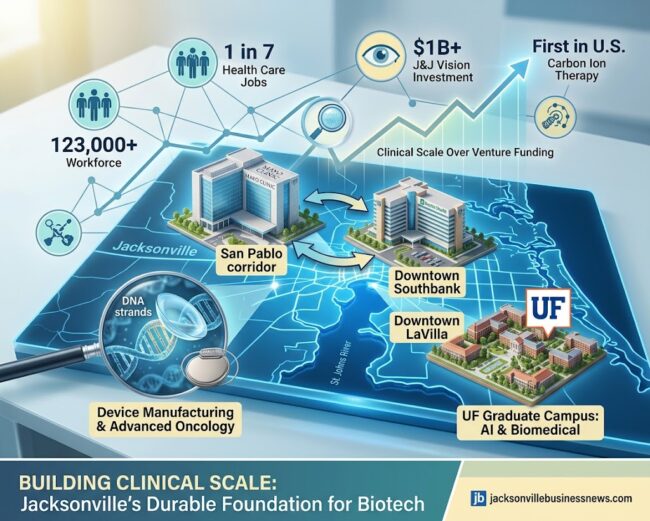
Jacksonville’s life sciences economy is built on clinical scale rather than venture-funded lab science. Mayo Clinic, Baptist Health and UF Health anchor a fast-growing care and research base, while Johnson & Johnson, Medtronic and other device makers anchor manufacturing. The region’s main gaps are purpose-built lab space and early-stage biotech capital.
Key Takeaways
| Metric | Figure | Source |
|---|---|---|
| Regional life sciences workforce | 123,000+ | JAXUSA Partnership |
| Share of regional jobs in health care | About 1 in 7 | JAXUSA Partnership |
| Mayo Clinic Florida hospital expansion | $432M, 121 beds | Mayo Clinic |
| Carbon ion therapy start (first in U.S.) | 2028 | Mayo Clinic |
| J&J Vision investment, June 2026 | $1B+ | Johnson & Johnson |
| J&J Jacksonville employees | ~3,500 | Johnson & Johnson |
| Proton therapy centers in region | 3 | JAXUSA Partnership |
| State health innovation loans | $50M a year through 2034 | Florida Department of Health |
The Pillars of Jacksonville Healthcare
Direct answer: Three health systems define Jacksonville’s medical economy: Mayo Clinic Florida, Baptist Health and UF Health Jacksonville. Each is in a multi-year expansion. Together they create the patient volume, clinical expertise and research activity that draw device makers, health-tech firms and clinical trial sponsors to Northeast Florida.
Mayo Clinic Florida
Mayo Clinic’s Jacksonville campus off San Pablo Road is one of only three Mayo destination campuses in the world, alongside Rochester, Minnesota, and Phoenix. Its gravitational pull on the regional economy is hard to overstate.
The current growth phase is large:
| Project | Scope | Status |
|---|---|---|
| Hospital tower expansion | 5 new floors, 121 beds including 56 ICU beds | Completion targeted for end of 2026 |
| Duan Family Building | 228,000 sq ft cancer treatment and research | Opened June 2025 |
| Proton therapy | Particle therapy in Duan Building | Expected 2027 |
| Carbon ion therapy | First program in the U.S. | Expected 2028 |
| Emergency department | 12,000 sq ft expansion | Part of campus build-out |
Mayo announced the $432 million hospital expansion to meet rising demand for complex care in neurology, cardiology, cancer and transplant medicine. When complete, the hospital is expected to reach 13 floors and 428 beds. Mayo has said it invested more than $1 billion in Florida construction since 2016, roughly doubling its space by 2026.
The carbon ion program is the headline. Carbon ion therapy uses heavy charged particles to target radiation-resistant tumors while limiting damage to surrounding tissue. Before Mayo’s program, it was available only at a small number of centers in Asia and Europe. Mayo began working with Hitachi on the technology in 2019. Gov. Ron DeSantis said the state contributed $30 million to the facility and program, and carbon ion treatments are expected to begin in 2028, initially through clinical trials.
For the regional economy, the significance goes beyond patient care. A first-in-the-hemisphere treatment draws patients, physicians, researchers and trial sponsors from across the country.
Baptist Health
Baptist Health is Jacksonville’s locally governed, nonprofit health system, with hospitals on the Downtown Southbank, in the Bartram area, at the Beaches and in Nassau County, plus Wolfson Children’s Hospital and Baptist MD Anderson Cancer Center.
Recent moves include:
- A new emergency tower on its Downtown campus, with a city permit for phases two through six valued at $187.4 million covering about 124,000 square feet, according to the Jacksonville Business Journal
- A pediatric realignment: Baptist ended its decades-long pediatric clinical partnership with UF Health, transitioning services at Wolfson Children’s Hospital to Nemours Children’s Health in early 2026. Wolfson remains the main pediatric teaching facility for the UF College of Medicine.
That split was notable. UF Health said publicly it was surprised and disheartened by the decision, and it signals more competition among Jacksonville health systems for physicians, patients and specialty programs.
UF Health Jacksonville
UF Health Jacksonville, the University of Florida’s academic medical center in the city, operates the region’s Level I trauma center on Eighth Street near Springfield and a second campus, UF Health North, near River City Marketplace.
Its investments include:
- A new trauma center, supported by $80 million in state funding
- A $33.5 million emergency and trauma center addition at its Eighth Street campus, permitted in January 2026, according to the Jacksonville Daily Record
- A six-story, 120-bed expansion at UF Health North
Why Scale Matters
| System | Economic Role |
|---|---|
| Mayo Clinic | Destination care, research, advanced oncology |
| Baptist Health | Largest local system, pediatrics, cancer network |
| UF Health Jacksonville | Academic medicine, trauma, teaching |
| Ascension St. Vincent’s, HCA Florida | Community hospital capacity |
| Brooks Rehabilitation, Nemours | Specialty care |
JAXUSA Partnership reports that about one in seven jobs in the region is in health care. The region also has three proton therapy centers, more than any other U.S. city, according to JAXUSA. That concentration makes Jacksonville a natural market for companies selling into hospitals, recruiting clinicians or running clinical research.
The Rise of Health-Tech and Biotech Real Estate
Direct answer: Jacksonville’s healthcare real estate boom is concentrated in hospital towers, medical office buildings and manufacturing plants, not speculative lab space. The region has very little multi-tenant wet lab inventory, which is both a constraint for startups and an opportunity for developers willing to build ahead of demand.
Manufacturing Leads the Way
The largest private life sciences investment in Jacksonville this year was not a research building. It was a factory expansion.
In June 2026, Johnson & Johnson announced it will invest more than $1 billion in Jacksonville to expand U.S. manufacturing, packaging and distribution for its ACUVUE contact lenses, including a new distribution facility near Jacksonville International Airport. The company has operated in Jacksonville since 1981, employs about 3,500 people locally, and manufactures more than 1.7 billion contact lenses a year for U.S. patients. The project is part of J&J’s broader $55 billion U.S. investment commitment through early 2029, and it is set to receive $12 million in city incentives.
Other device makers with a meaningful regional presence include:
| Company | Jacksonville Role |
|---|---|
| Johnson & Johnson Vision | Contact lens manufacturing and divisional HQ |
| Medtronic | Ear, Nose and Throat (ENT) division operations |
| Zimmer Biomet | Device operations |
| KLS Martin Group | Surgical device operations |
| Thermo Fisher Scientific | Regional operations |
| Treace Medical Concepts | Regional presence |
Medtronic has described the Jacksonville region as a recognized hub in its global network, citing talent, transportation and logistics.
Health Tech: The Quiet Strength
Jacksonville’s health-tech sector is larger than many outsiders realize, built on the city’s long history in insurance, payments and data processing.
- Availity, headquartered in Jacksonville, operates one of the nation’s largest health information networks connecting payers and providers.
- Mosai (formerly Forcura) works on home health and post-acute care coordination.
- One Call and Optimum Healthcare IT operate in the region.
- Florida Blue, the state’s largest health insurer, is headquartered in Jacksonville.
This mix gives health-tech startups something many biotech hubs lack: nearby enterprise customers. A startup selling claims automation or care coordination software can find payers, hospitals and post-acute providers within a short drive.
The Lab Space Gap
Wet lab space, with specialized ventilation, plumbing, gas lines and vibration control, is what research-stage biotech companies need. Jacksonville has very little of it outside of institutional campuses.
Colliers life sciences specialist Mike Brown, who is based in Jacksonville, told the Jacksonville Business Journal in 2020 that the region had a foundation to build a life sciences cluster, anchored by Mayo, but almost no inventory of certain specialized space. That basic picture still holds for multi-tenant lab buildings.
| Space Type | Jacksonville Availability | Who Uses It |
|---|---|---|
| Hospital and clinical | Expanding rapidly | Health systems |
| Medical office buildings | Strong, growing | Physicians, outpatient care |
| Manufacturing / cleanroom | Established, corporate-owned | Device makers |
| Clinical trial space | Within health systems | Sponsors, CROs |
| Multi-tenant wet lab | Limited | Research-stage biotech |
| Dry lab / tech office | Available | Health-tech, data |
There are cost advantages for anyone willing to build. JAXUSA reports construction costs about 11% below the national average and office rents averaging $25.90 per square foot. Those numbers help the economics of purpose-built lab or clinical space compared with established hubs like Boston or San Diego.
Where Activity Is Clustering
- Southside and San Pablo corridor, around Mayo Clinic
- Downtown Southbank, around Baptist Health and MD Anderson
- Downtown Northbank and LaVilla, where UF’s graduate campus is planned
- Springfield and the Eighth Street corridor, around UF Health Jacksonville
- North Jacksonville near JIA, where J&J’s new distribution facility and UF Health North are located
Talent Pipeline and Academic Collaboration
Direct answer: Jacksonville’s health talent pipeline is expanding. UF is opening a downtown graduate campus with programs in AI for biomedical and health sciences, Jacksonville University is adding an osteopathic medical school, and regional colleges supply nurses, technicians and allied health workers. JAXUSA counts more than 123,000 life sciences professionals in the region.
UF’s Downtown Graduate Campus
The most important new academic project is the University of Florida’s graduate campus in Downtown Jacksonville. UF selected the LaVilla area around the Prime F. Osborn III Convention Center, with the city providing roughly 22 to 23 buildable acres. Classes are beginning in an existing building while the permanent campus is designed and built.
Announced programs include:
- Master’s in AI in Biomedical and Health Sciences
- Master’s in Computer Science with concentrations in AI and cybersecurity
- Master’s in Engineering Management with a data analytics concentration
- Professional MBA and a Master’s in Management with an AI concentration
- Master’s in the Study of Law for compliance professionals
UF has said full build-out enrollment could reach 20,000 or more. The campus will also house the Florida Semiconductor Institute, and UF has pledged to build a research presence in the city. Its location about two miles from UF Health Jacksonville is intended to tie graduate education to clinical practice.
Medical Education Grows
Jacksonville University is opening a branch of the Lake Erie College of Osteopathic Medicine (LECOM), with an initial class of about 75 students in fall 2026, growing to 150 per year by 2030, according to the Jacksonville Business Journal. That adds a physician training pipeline the region has long lacked.
Regional Partners
| Institution | Health and Life Sciences Role |
|---|---|
| University of Florida (Jacksonville) | Graduate AI, health and engineering programs; medical school campus |
| University of North Florida | Nursing, public health, health administration, biomedical sciences |
| Jacksonville University | Nursing, PA studies, therapy programs, LECOM |
| Florida State College at Jacksonville | Nursing, surgical tech, respiratory care, biotechnology |
| Edward Waters University | Biology, chemistry, public health |
| Keiser University | Nursing, radiologic technology, sonography |
The region also benefits from four major military installations, which produce veterans with technical and medical training who often transition into clinical and operations roles.
The Clinical Trial Advantage
Clinical trials need patients, investigators and infrastructure. JAXUSA points to a regional population of about 1.9 million and multiple academic and research-intensive medical centers as reasons the region is a credible clinical research site. Mayo’s carbon ion program, which will start through clinical trials, adds a high-profile anchor for oncology research.
Regulatory and Commercialization Hurdles
Direct answer: Jacksonville medical device and biotech startups face the same federal hurdles as companies anywhere: FDA clearance or approval, clinical evidence, reimbursement and data privacy. The local challenges are thinner early-stage capital and limited lab space. Florida offers low-interest health innovation loans, and federal SBIR grants were renewed through 2031.
The Federal Pathway
For device companies, the FDA pathway depends on risk classification:
| Pathway | Typical Use | Relative Burden |
|---|---|---|
| 510(k) clearance | Devices similar to existing products | Lower |
| De Novo | Novel low-to-moderate risk devices | Moderate |
| Premarket Approval (PMA) | High-risk devices | Highest, often requires clinical trials |
| IND / NDA / BLA | Drugs and biologics | Highest, multi-phase trials |
Beyond FDA, startups must plan for reimbursement from Medicare and private insurers, HIPAA and data security for health-tech products, and quality system requirements for manufacturing. Many promising products stall not at regulatory approval but at reimbursement, when payers decline to cover a new device or service.
Florida-Specific Considerations
- Facility licensing through the Agency for Health Care Administration applies to many care delivery models.
- The Florida Health Care Innovation Program, created by SB 7018 in 2024, offers revolving loans at a maximum 1% interest rate, up to $5 million per project, covering up to 50% of project costs (80% for rural or underserved applicants), with 10-year terms. Eligible applicants are licensed health care facilities and educational or clinical training providers partnering with them. The state budgets $50 million a year for the program through 2034.
- Cancer research funding through the Casey DeSantis Cancer Research Program has expanded state support for oncology research.
Startups typically cannot borrow directly from the innovation loan program, but they can partner with a licensed hospital or health system that applies to deploy their technology, which can be a meaningful path to a first major customer.
Funding Rounds
Early-stage capital remains Jacksonville’s biggest gap for research-intensive biotech. Health-tech companies with revenue have found local and Florida investors more readily than pre-revenue drug developers. Founders commonly combine:
- Federal non-dilutive funding, including SBIR and STTR grants from NIH and other agencies, which were reauthorized in April 2026 through September 30, 2031, after a roughly six-month lapse
- Health system partnerships, including pilot contracts, co-development or strategic investment
- Florida angel networks and funds
- National specialist investors for later-stage rounds
Market Entry Through Local Health Systems
The most practical commercialization advantage in Jacksonville is access to customers. A device or software startup that can run a pilot inside Mayo, Baptist or UF Health generates clinical evidence, references and revenue at the same time. That model favors companies solving operational problems hospitals already feel, such as capacity, staffing, revenue cycle and care coordination.
Common Pitfalls
| Pitfall | How to Avoid It |
|---|---|
| Underestimating FDA timeline | Engage FDA early through pre-submission meetings |
| Ignoring reimbursement | Model payer coverage before final design |
| Weak clinical evidence | Partner with a local health system for pilots |
| Lab space delays | Negotiate institutional space or plan purpose-built facilities early |
| Single-source funding | Layer grants, loans, strategic and equity capital |
Strategic Recommendations for Executives
Direct answer: Executives entering Jacksonville’s health economy should lead with partnerships, not facilities. Build relationships with the major health systems and UF, use non-dilutive funding first, and plan real estate early because specialized space is scarce. Health-tech and device companies are best positioned today; pure biotech requires more patience.
| If You Are… | Prioritize |
|---|---|
| A health-tech startup | Pilots with health systems; payer customers like Florida Blue |
| A medical device company | Manufacturing talent, logistics, FDA strategy |
| A biotech startup | Institutional lab access, SBIR/STTR, specialist investors |
| A developer or investor | Medical office, clinical space, potential lab conversions |
| A health system vendor | Mayo, Baptist and UF Health expansion timelines |
Brian’s Take
When I evaluated companies as an investor, I learned to separate a market’s story from its revenue. Jacksonville’s life sciences story is often told as a biotech story. The revenue says otherwise. The money is in clinical care, device manufacturing and health data, and those three are growing fast.
That is not a weakness. J&J’s billion-dollar commitment, Mayo’s carbon ion program and UF’s graduate campus are long-term, hard-to-move investments. They create a durable foundation, which is exactly what most aspiring biotech hubs lack.
The gap is the middle: wet labs, seed capital and the dense network of scientists-turned-founders that Boston and San Diego took decades to build. Jacksonville will not close that gap quickly, and it does not need to copy those cities. Its best path is to commercialize what its hospitals and manufacturers already know. The health-tech and device companies that plug into that system are the ones I would watch.
Frequently Asked Questions
What are the largest healthcare employers in Jacksonville?
The major health systems are Mayo Clinic Florida, Baptist Health and UF Health Jacksonville, along with Ascension St. Vincent’s, HCA Florida and Nemours. Florida Blue and Johnson & Johnson Vision are also major health-related employers.
What is carbon ion therapy at Mayo Clinic Jacksonville?
Carbon ion therapy is an advanced radiation treatment using heavy charged particles to target hard-to-treat tumors. Mayo Clinic’s Jacksonville program will be the first in the United States and the Western Hemisphere, with treatments expected to begin in 2028.
Does Jacksonville have wet lab space for biotech startups?
Supply is limited. Most specialized lab space sits within health systems, universities and corporate facilities. Multi-tenant wet lab inventory is scarce, though lower construction costs make purpose-built projects more feasible than in established hubs.
What is the UF graduate campus in Jacksonville?
The University of Florida is building a Downtown graduate campus in LaVilla focused on AI, health sciences, engineering and business, including a Master’s in AI in Biomedical and Health Sciences. UF says enrollment could eventually reach 20,000 or more.
What funding is available for Florida health innovation?
Options include federal SBIR and STTR grants, reauthorized through 2031, and Florida’s Health Care Innovation revolving loans of up to $5 million at no more than 1% interest for licensed facilities and partners. Health system partnerships and private investors fill remaining gaps.
Why are medical device companies locating in Jacksonville?
Companies cite skilled manufacturing talent, logistics infrastructure, lower costs and Florida’s tax structure. Johnson & Johnson Vision, Medtronic, Zimmer Biomet and KLS Martin all operate in the region.
Is Jacksonville a good market for clinical trials?
The region offers a population of about 1.9 million and several research-active medical centers, including Mayo Clinic, UF Health and Baptist MD Anderson, making it a credible site for clinical research.
Sources and Further Reading
- JAXUSA Partnership, Life Sciences industry overview (2026)
- Mayo Clinic News Network, “Mayo Clinic invests in major hospital expansion to enhance patient experience”
- First Coast News, Mayo Clinic hospital expansion to 13 floors and 428 beds
- HealthExec, “Mayo Clinic invests $432M in Florida hospital expansion project”
- Mayo Clinic News Network, Duan Family Building and carbon ion therapy (June 2025)
- Executive Office of the Governor, Mayo Clinic carbon ion therapy program announcement (2026)
- Fox 35 Orlando, Florida’s first carbon ion cancer therapy program
- Jacksonville Today, “Mayo Clinic in Jax will offer groundbreaking cancer therapy” (June 11, 2025)
- News4Jax, “Johnson & Johnson to invest more than $1 billion in Jacksonville” (June 15, 2026)
- Area Development, Johnson & Johnson Vision Jacksonville expansion (June 23, 2026)
- Jacksonville Daily Record, “Johnson & Johnson leaders tout contact lens growth” (July 23, 2026)
- Business Facilities, “Jacksonville Fosters Growth, Innovation for Medical Device Manufacturers”
- Becker’s Hospital Review, “Baptist Health Jacksonville ends partnership with UF Health”
- Jacksonville Business Journal via CareerSource Northeast Florida, Baptist and Mayo tower approvals
- Jacksonville Daily Record, “Development Today: UF Health approved for $33.51 million addition” (February 3, 2026)
- The Capitolist, UF Health Jacksonville facility expansion and trauma center funding
- University of Florida News, “UF moves forward with site for new campus in Jacksonville” (December 2024)
- Jacksonville Daily Record, LaVilla site selected for UF graduate campus and Semiconductor Institute (December 12, 2024)
- Construction Equipment Guide, UF graduate campus in Downtown Jacksonville
- Jacksonville Business Journal via CareerSource Northeast Florida, 2022 health care expansion and LECOM at Jacksonville University
- Jacksonville Business Journal via CareerSource Northeast Florida, Colliers life sciences outlook for Jacksonville (August 2020)
- Florida Department of Health, Health Care Innovation Program and Revolving Loan Program
- Florida Department of Health, Health Care Innovation Revolving Loan Program launch announcement (October 2025)
- North Carolina Military Business Center, SBIR/STTR Reauthorization Progress Update (2026)
About the Author