Quick Answer: Jacksonville offers businesses no state personal income tax, a 5.5% corporate rate, Florida’s busiest container port, a 1-million-plus population, and more buildable land than any other city in the lower 48 states.
Why Size Matters for Business
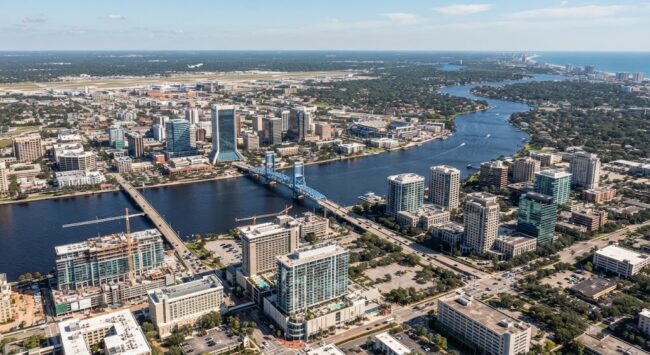
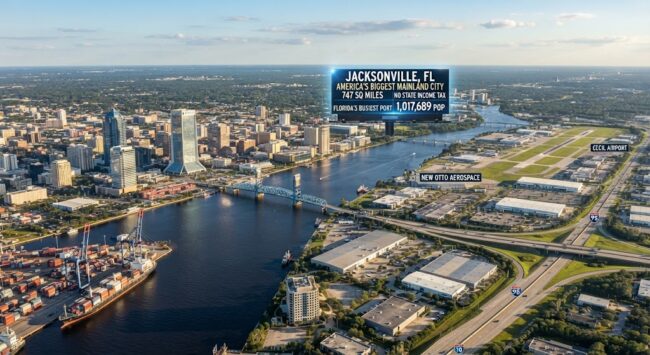
Most American cities are boxed in by neighboring towns. Jacksonville is not. At 747 square miles, Jacksonville is the largest city in the contiguous United States by land area, and it has more than 127 square miles of water on top of that.
That footprint is the result of a political decision, not geography alone. City-county consolidation extended Jacksonville’s boundaries to take in most of Duval County’s population, making it the largest city by total area, land and water, in the contiguous U.S. The arrangement took effect in 1968, and the city of Jacksonville provides all services that a county government would normally provide.
For a company, that means one set of city rules, one permitting system and one local government across a territory larger than many metro regions elsewhere.
Jacksonville at a Glance
| Metric | Figure |
|---|---|
| Land area | 747 sq mi |
| City population (July 2025) | 1,017,689 |
| Growth since 2020 | +7.2% |
| Metro population (2025 est.) | ~1.79 million |
| Density (2020) | ~1,271 per sq mi |
| State personal income tax | None |
| Corporate income tax | 5.5% |
Advantage 1: A Large, Growing Customer and Labor Base
Jacksonville is Florida’s most populous city. Census estimates put the city at 1,017,689 residents as of July 1, 2025, up 7.2% from the April 2020 base. That ranks it #11 nationally and #1 in Florida.
The broader market is larger still. The metro area was estimated at 1,785,500 people in 2025. For employers, that is a sizable hiring pool; for consumer brands, it is a growing local market.
Advantage 2: Room to Build
Space is the advantage few competing cities can match. Because the city’s population is spread across so much land, density was about 1,270 people per square mile in 2020, which is low for a city of a million people.
In practical terms, this gives companies more options for large campuses, distribution centers and manufacturing sites inside city limits. A recent example: Otto Aerospace plans to invest up to $430 million in two phases at Cecil Airport, including a facility to build its Phantom 3500 aircraft and a headquarters relocation from Fort Worth, bringing more than 1,200 new jobs.
Advantage 3: Florida’s Tax Structure
Florida’s tax code is a major draw, and Jacksonville gets all of it.
- No personal income tax. This protection is written into the state constitution. Article VII, Section 5 of the Florida Constitution bars the legislature from imposing an income tax on individuals, and changing that would take a statewide referendum.
- Competitive corporate rate. Florida’s corporate income tax rate is 5.5%, and the first $50,000 of net income is exempt. Pass-through entities such as most LLCs and S corporations generally pay no state income tax at the entity level.
- National ranking. Florida ranks 5th overall on the Tax Foundation’s 2026 State Tax Competitiveness Index.
The local economic development group adds that Jacksonville has no corporate franchise tax, no personal income tax and no taxes on inventories.
Tax Snapshot
| Tax | Florida / Jacksonville |
|---|---|
| Personal income tax | None |
| Corporate income tax | 5.5% (first $50K exempt) |
| State sales tax | 6% plus local surtax |
| Inventory tax | None |
Advantage 4: A Logistics Hub With a Deepwater Port
Jacksonville sits at the meeting point of I-95 and I-10, with major rail and a working seaport. JAXPORT moved 1,388,841 container units (TEUs) in fiscal 2025, a 4% gain over fiscal 2024. It is also a leading auto port: vehicle volumes totaled 506,237 in 2025, even with 89 acres out of service.
Capacity is growing. A $72 million modernization of the SSA Jacksonville Container Terminal brings JAXPORT’s total capacity to roughly 2 million TEUs a year, nearly double its current throughput. The economic reach is large: port cargo activity supported more than 228,100 Florida jobs and $44 billion in annual economic output in 2024.
Advantage 5: A Headquarters Track Record
Jacksonville has built a reputation as a headquarters city. The JAXUSA Partnership describes it as Florida’s headquarters capital, citing four Fortune 500 companies, more than 150 headquarters and a cost-of-living index of 93.1.
Financial technology is a standout cluster. FIS, the world’s largest fintech company by revenue, opened its global headquarters in Jacksonville, and Dun & Bradstreet relocated its global headquarters to the city from New Jersey. Dun & Bradstreet’s move was set to create 500 high-wage jobs over five years and $75 million in capital investment.
Momentum continued in 2025. Northeast Florida recorded 12 project announcements, more than 2,400 new jobs and nearly $1 billion in capital investment that year.
Advantage 6: Help With Relocation and Incentives
Companies don’t have to navigate a move alone. JAXUSA Partnership, the nonprofit economic development division of JAX Chamber, covers seven Northeast Florida counties and says it has helped create more than 133,000 jobs and $12.1 billion in capital investment through 2024. Its team assists executives and site consultants through site selection.
Incentives can be meaningful. When fintech firm Nymbus moved its headquarters downtown, its package included a city Targeted Industry Grant of up to $1.8 million and a CareerSource Florida Quick Response Grant of up to $2.7 million.
The Trade-Offs to Weigh
Size cuts both ways. Low density means most commuting is by car, and drive times across the city can be long. Utility, road and service costs are spread over a very large area. Coastal and river exposure also makes hurricane planning and property insurance part of any site decision. Businesses should model commute patterns and insurance costs for specific sites, not just the citywide averages.
Brian’s Take
Jacksonville’s pitch is simple and hard to copy: Florida’s tax code, a real port, and land. Miami and Tampa can match the taxes, but neither can offer large, buildable parcels inside a single city government the way Jacksonville can. The Otto Aerospace win shows the formula working for manufacturing, and the FIS and Dun & Bradstreet moves show it works for white-collar headquarters too. The risk to watch is whether infrastructure and housing keep pace with growth spread across 747 square miles. For a company that needs room to expand without leaving the lower 48’s biggest city, Jacksonville is the first call to make in Florida.
Frequently Asked Questions
Is Jacksonville the largest city in the United States?
By land area, it is the largest city in the contiguous (lower 48) United States, at about 747 square miles of land. Several cities in Alaska, such as Sitka, are larger in total area.
What is Jacksonville’s population?
The city had an estimated 1,017,689 residents as of July 1, 2025, making it Florida’s largest city and the 11th largest in the U.S.
Does Jacksonville have a state income tax?
No. Florida has no personal income tax. C corporations pay a 5.5% state corporate income tax on income above a $50,000 exemption.
Why do companies move headquarters to Jacksonville?
Common reasons include Florida’s tax structure, lower operating and living costs than many large metros, available land, logistics access through JAXPORT and the interstate system, and an established finance and fintech workforce.
Who helps businesses relocate to Jacksonville?
JAXUSA Partnership, the economic development arm of JAX Chamber, assists with site selection, incentives and workforce connections.
Sources and Further Reading
- U.S. Census Bureau, QuickFacts: Jacksonville city, Florida – https://www.census.gov/quickfacts/fact/table/jacksonvillecityflorida/PST045224
- EBSCO Research Starters, Jacksonville, Florida – https://www.ebsco.com/research-starters/geography-and-cartography/jacksonville-florida/
- Wikipedia, Jacksonville, Florida – https://en.wikipedia.org/wiki/Jacksonville,_Florida
- Wikipedia, Jacksonville Metropolitan Area – https://en.wikipedia.org/wiki/Jacksonville_metropolitan_area
- JAXPORT, Financial Reports – https://www.jaxport.com/corporate/about-jaxport/financial-reports/
- JAXPORT, Growth Outlook Release – https://www.jaxport.com/jaxport-growth-outlook-includes-business-diversification-new-trade-lane-connectivity/
- Tax Foundation, Florida State Tax Competitiveness Index 2026 – https://taxfoundation.org/statetaxindex/states/florida/
- Bookkeeping and Accounting Inc., Florida Corporate Income Tax 2026 Guide – https://www.bookkeepingandaccountinginc.com/florida-corporate-income-tax/
- Reed Corp, Florida No State Income Tax Guide – https://reedcorp.tax/helpful-guides/miami-cpa-firm/florida-no-state-tax-explained/
- JAXUSA Partnership, Corporate Operations – https://jaxusa.org/industry/corporate-operations/
- JAXUSA Partnership, 2025 Jobs and Investment Recap – https://jaxusa.org/news/northeast-florida-sees-2400-new-jobs-nearly-1b-in-capital-investment-in-2025/
- JAXUSA Partnership, Paysafe North American HQ – https://jaxusa.org/news/paysafe-to-open-north-american-headquarters-in-jacksonville/
- Business Facilities, Dun & Bradstreet HQ Relocation – https://businessfacilities.com/dun-bradstreet-relocating-corporate-hq-jacksonville-florida/
- Downtown Investment Authority, Nymbus HQ Relocation – https://dia.jacksonville.gov/news/fintech-company-moving-headquarters-to-downtown-jax,-bringing-600-jobs
- JAXUSA Partnership, About – https://jaxusa.org/about/
About the Author