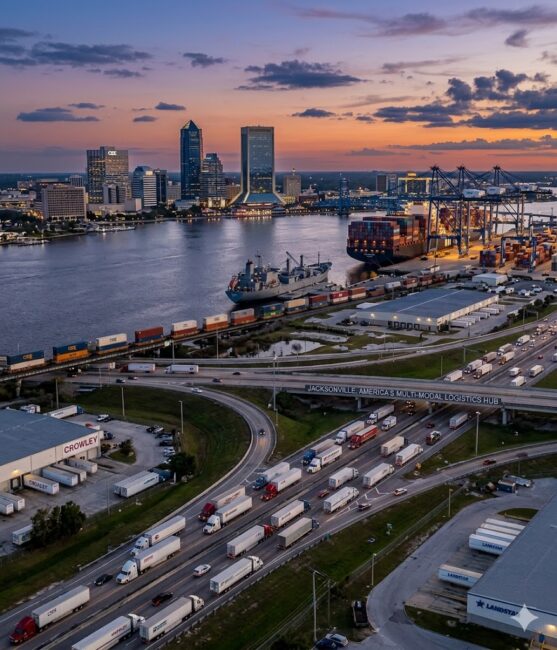
The Top 3 Logistics Companies in Jacksonville, FL: Inside the Engine Room of Northeast Florida’s Supply Chain Economy
There’s a moment, somewhere on the Dames Point Bridge crossing the St. Johns River, when you look down and finally understand what Jacksonville actually is.
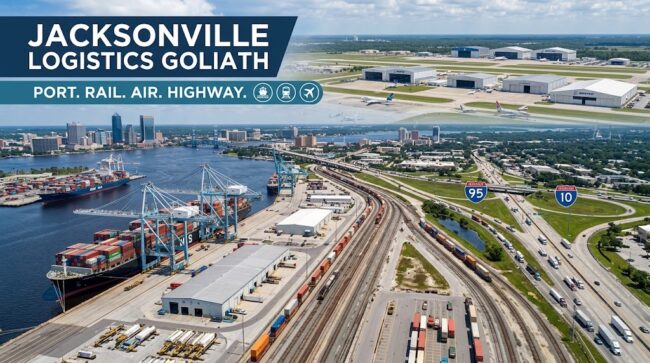
Below you, a Roll-On/Roll-Off vessel discharges thousands of imported vehicles. Container cranes work the Blount Island terminal in steady rhythm. Freight trains snake through the rail yards visible to the west. Trucks queue along the port access roads. Cargo aircraft turn final approach toward Jacksonville International Airport in the distance. Naval ships sit at Mayport. The sheer volume of goods, vehicles, fuel, and freight moving through this single American city in a single day is staggering — and almost completely invisible to the average Floridian going about their day.
This is Jacksonville’s secret identity: a logistics powerhouse hiding in plain sight, generating roughly $31 billion in annual economic impact, supporting more than 138,000 jobs in port operations alone, and quietly serving as one of the most strategically essential pieces of supply chain infrastructure on the entire Eastern Seaboard.
While Florida headlines focus on Miami’s financial migration, Tampa’s growth, and Orlando’s tourism economy, Jacksonville goes about its work — moving the cars Floridians drive, the consumer goods that fill regional stores, the building materials that supply the construction boom, the military cargo that supports national defense, and the international freight that connects American consumers to global supply chains.
This article walks through three of the largest and most strategically significant logistics companies anchored in Jacksonville in 2026 — operations that collectively define the city’s identity as one of America’s most consequential supply chain hubs and demonstrate why Northeast Florida has emerged as a genuinely critical piece of national logistics infrastructure.
What Makes Jacksonville Different From Every Other Logistics City
Before getting to the companies themselves, it’s worth pausing on what genuinely distinguishes Jacksonville from other major American logistics centers.
Most logistics hubs do one or two things well. Memphis is an air cargo capital. Long Beach and Los Angeles dominate Pacific container shipping. Chicago anchors rail. Atlanta concentrates trucking and distribution. Each excels in specific modes while depending on others.
Jacksonville does everything.
The city operates one of the largest deepwater ports on the East Coast. It hosts the corporate headquarters of one of North America’s seven Class I freight railroads. It anchors a massive trucking and asset-light freight ecosystem. It supports substantial air cargo through a major international airport. It serves as a cornerstone of American naval logistics through Mayport and NAS Jacksonville. It hosts one of the largest concentrations of vehicle import operations in the country. It supports massive distribution and fulfillment infrastructure. It connects to virtually every major Eastern American market through I-95, I-10, and I-75 corridors.
That comprehensive multi-modal capability is genuinely rare. Most American cities can claim two or three of these capabilities. Jacksonville claims them all simultaneously — and at scale.
The companies anchoring this ecosystem reflect that distinctive multi-modal character. They aren’t all one type of logistics company. They span rail, maritime, asset-light trucking, port operations, air cargo, and specialty logistics — collectively constituting one of the most genuinely diversified logistics industry concentrations in the United States.
Brian’s Take: Jacksonville’s Multi-Modal Logistics Capability Is Genuinely Distinctive in American Industry.
Most American logistics conversations focus on specific modes — Memphis for air, the West Coast ports for Pacific shipping, Chicago for rail, Atlanta for trucking — but Jacksonville’s distinctive achievement is doing all of them simultaneously and at meaningful scale. That comprehensive multi-modal capability creates strategic flexibility that single-mode logistics cities simply cannot match, and it’s one of the most underappreciated reasons Jacksonville continues attracting major logistics investment from companies that need genuine multi-modal options rather than mode-specific specialization. Florida operators thinking about supply chain dependencies should pay particular attention to Jacksonville’s distinctive position because the city’s infrastructure supports business activity across virtually every Florida industry.
— Brian
1. CSX Corporation — Where the Eastern Half of America’s Freight Rail Begins
Headquarters: 500 Water Street, Jacksonville, FL 32202 Stock Listing: NASDAQ: CSX Industry Position: Class I freight railroad Network Scale: Approximately 20,000 route miles across 23 states, the District of Columbia, and Canadian provinces Website: csx.com
You can stand on the Northbank in downtown Jacksonville and look up at the CSX building knowing you’re looking at the corporate command center of one of seven Class I freight railroads in North America — a company whose locomotives haul roughly 6 million carloads of freight annually, whose tracks reach into nearly half the United States, and whose strategic decisions made from Jacksonville influence supply chain dynamics for thousands of American businesses and millions of consumers.
CSX isn’t just a Jacksonville logistics company. It’s a piece of American economic infrastructure — and it’s headquartered in Florida.
What Actually Moves on CSX Trains
The freight categories CSX hauls illustrate exactly how essential rail remains to the American economy:
- Intermodal containers moving consumer goods, retail merchandise, and manufactured products between ports, distribution centers, and inland markets
- Coal and other energy products supporting power generation and industrial uses
- Automotive products including finished vehicles, auto parts, and supplies — particularly relevant given Jacksonville’s role as a major vehicle import gateway
- Chemicals and petrochemical products essential to manufacturing supply chains across the Eastern United States
- Agricultural products including grain, ethanol, and food products
- Metals and construction materials supporting industrial and construction activity
- Forest products including paper, pulp, and lumber
- Aggregates and minerals supporting construction and industrial customers
This diversity of cargo categories reflects rail’s continued essential role in American supply chains — handling the kinds of heavy, bulk, and long-distance freight that simply cannot be efficiently moved by truck alone.
Why Jacksonville for the Headquarters
CSX’s corporate identity has long been intertwined with Jacksonville. The company’s headquarters in downtown Jacksonville anchors not just executive operations but substantial finance, technology, operations, marketing, and supporting infrastructure — making the city one of the most consequential Class I railroad headquarters cities in North America.
The Jacksonville location reflects multiple strategic factors:
- Central position within CSX’s eastern American network
- Florida tax environment beneficial to corporate operations
- Continued availability of executive talent willing to live and work in the region
- Strong civic relationships built across decades of CSX’s Jacksonville presence
- Major corporate infrastructure developed specifically to support CSX’s headquarters operations
For downtown Jacksonville, CSX represents one of the most consequential corporate anchors — generating substantial tax revenue, supporting hundreds of professional jobs, providing significant philanthropic engagement, and contributing to the city’s continued evolution as a major American corporate headquarters city.
The Continued Investment Story
CSX continues making substantial capital investments across multiple dimensions:
- Network infrastructure improvements including track upgrades, bridge replacements, and capacity expansions
- Locomotive fleet modernization with focus on fuel efficiency and reliability
- Technology investments in operations management, customer service, and broader digital capabilities
- Intermodal terminal development supporting the continued growth of intermodal freight
- Safety and environmental programs addressing both regulatory requirements and operational priorities
The continued capital deployment reflects CSX’s strategic positioning for continued growth across the Eastern American freight rail market.
What Florida Business Owners Should Understand
For Florida businesses across virtually every major industry category, CSX’s operations directly affect supply chain costs, capacity, and reliability. Manufacturers, retailers, agricultural producers, automotive operations, energy companies, and dozens of other Florida business categories depend on CSX’s network for inbound supplies, outbound products, or both.
Engaging strategically with CSX’s capabilities — including evaluating intermodal options, understanding rate structures, and building relationships with customer service teams — represents a meaningful competitive opportunity for Florida businesses willing to think comprehensively about their logistics strategies.
Brian’s Take: CSX’s Jacksonville Headquarters Is One of the Most Underappreciated Florida Corporate Anchors.
Most discussions of major Florida-headquartered companies focus on names like Publix, Disney, and AutoNation, but CSX is genuinely one of the most consequential Florida-headquartered corporations measured by national economic significance — a NASDAQ-listed Class I railroad whose strategic decisions made in downtown Jacksonville affect thousands of American businesses and millions of consumers across half the United States. Florida business leaders should pay particular attention to CSX’s continued evolution because the company’s investment decisions, operational changes, and strategic direction substantially influence the broader logistics environment that virtually every Florida industry depends on.
— Brian
2. Crowley — Where American-Owned Maritime Operations Meet Modern Supply Chain
Headquarters Operations: Jacksonville, Florida Founded: 1892 in San Francisco; corporate headquarters relocated to Jacksonville in 2017 Industry Position: American-owned global maritime, logistics, energy, and supply chain services Operational Reach: Global, with particular strength in Caribbean, Latin American, and U.S. domestic markets Website: crowley.com
When Crowley relocated its corporate headquarters from California to Jacksonville in 2017, the move sent a clear signal about Jacksonville’s emergence as a serious American maritime center. A company with more than 130 years of operating heritage — founded during the Gilded Age and grown through every major American economic era since — chose Northeast Florida as its corporate base for the next chapter of its evolution.
The decision wasn’t arbitrary. Jacksonville’s combination of port infrastructure, maritime industry connections, military logistics partnerships, business-friendly environment, and strategic geographic position made the city a natural fit for one of America’s most distinguished privately held maritime operations.
What Distinguishes Crowley Among American Maritime Operators
The American maritime industry has consolidated dramatically over the past several decades. Many companies that historically operated under American ownership have been acquired by international shipping conglomerates, become subsidiaries of foreign-owned operations, or exited the industry entirely. Within that consolidation, Crowley occupies a distinctive position as a major American-owned, family-led maritime company still operating across multiple business segments at substantial scale.
That American ownership matters strategically:
- Government and military contracts often require American-flagged operations and American-owned operators
- Jones Act trade between U.S. ports requires American-built, American-crewed, American-flagged vessels operated by American-owned companies
- Strategic supply chain considerations increasingly favor American-controlled logistics options for critical cargo categories
- National security applications often work better with American-owned partners
The Diversified Business Portfolio
Crowley operates across multiple distinct business segments, each substantial in its own right:
Container Shipping
Crowley operates major container shipping services connecting the United States to Caribbean, Central American, and other markets. The company’s ships move enormous volumes of consumer goods, manufactured products, and other freight along these routes daily.
Logistics Services
Beyond pure shipping, Crowley provides comprehensive logistics services including freight forwarding, customs brokerage, warehousing, distribution, and supply chain management for customers requiring integrated solutions.
Energy Services
Crowley’s energy operations include petroleum transportation (particularly relevant to fuel distribution in markets dependent on water-based supply), specialty energy logistics, and increasingly support services for the offshore wind industry developing along the American East Coast.
Government Services
Crowley provides extensive logistics services to American military and government customers — including specialized vessel operations, ship management, supply chain support, and broader services that depend on American-flagged, American-owned capabilities.
Technical Services
The company’s technical services include ship management, marine engineering, and specialty maritime capabilities serving both commercial and government customers.
Wind Energy
As the American offshore wind industry develops, Crowley has positioned itself to provide specialized maritime services supporting wind farm development, installation, and operations.
What the Jacksonville Headquarters Means
Crowley’s Jacksonville headquarters anchors substantial executive, corporate, operational, and supporting infrastructure in Northeast Florida. The headquarters operations contribute meaningfully to:
- Downtown Jacksonville’s continued evolution as a major corporate headquarters city
- Florida’s broader maritime industry identity as the headquarters location of one of America’s most distinguished maritime companies
- Northeast Florida professional services demand as Crowley’s operations require sophisticated legal, accounting, technology, and consulting services
- Civic and community engagement through the company’s substantial Jacksonville-based philanthropic and civic activities
The Continued Strategic Evolution
Crowley continues evolving its business mix to reflect changing maritime industry dynamics:
- Continued investment in shipping operations serving traditional Caribbean and Latin American routes
- Expansion into offshore wind support as the American renewable energy industry develops
- Continued government services growth as American national security needs evolve
- Technology integration across operations
- Sustainability initiatives addressing both regulatory requirements and customer expectations
For Florida operators with maritime, logistics, or supply chain needs, Crowley represents one of the most distinguished American-owned options available — particularly for business situations where American ownership, government services capability, or specialized maritime expertise matter strategically.
Brian’s Take: Crowley’s Continued Independence and American Ownership Matter Strategically in Ways Most Operators Don’t Fully Appreciate.
In an American maritime industry that has consolidated dramatically over recent decades, Crowley’s continued status as a major American-owned, privately held, family-led operation represents something genuinely valuable for customers requiring American-flagged operations, government services capability, or strategic supply chain options that depend on American ownership. The company’s choice to anchor its corporate headquarters in Jacksonville — rather than larger maritime markets like New York, Houston, or the West Coast ports — reflects exactly the kind of strategic positioning that has helped Jacksonville emerge as a serious American maritime center beyond just its port operations.
— Brian
3. Landstar System — The Asset-Light Innovation That Reshaped American Trucking
Headquarters: 13410 Sutton Park Drive South, Jacksonville, FL 32224 Stock Listing: NASDAQ: LSTR Founded: 1968 Industry Position: Asset-light freight transportation and logistics services Distinctive Model: Network of approximately 9,000+ Business Capacity Owners (independent owner-operators) plus 11,000+ approved capacity providers Website: landstar.com
Most major trucking companies own their trucks, employ their drivers, and operate as traditional asset-heavy logistics businesses. Their balance sheets reflect billions of dollars in fleet equipment. Their workforces include thousands of employee drivers. Their operational models reflect a century of industrial-era trucking economics.
Landstar isn’t most major trucking companies.
The Jacksonville-headquartered, NASDAQ-listed company has built one of the most distinctive and consistently successful business models in American transportation — operating not as a traditional asset-heavy carrier but as an asset-light network connecting thousands of independent owner-operators with thousands of customers, supported by sophisticated technology, branding, customer relationships, and operational infrastructure.
The Business Capacity Owner Model
The defining feature of Landstar’s operations is its network of Business Capacity Owners (BCOs) — independent owner-operators who own their trucks, operate as independent business owners, and provide capacity through the Landstar network. The model offers substantial benefits to all participants:
For BCOs:
- Genuine business ownership with the autonomy of independent operations
- Access to Landstar’s customer base without the overhead of independent customer development
- Brand backing of a major NASDAQ-listed transportation company
- Operational support including technology, fuel programs, insurance options, and broader services
- Earnings potential that can substantially exceed traditional employee driver compensation
For Landstar:
- Asset-light balance sheet without the capital intensity of fleet ownership
- Variable cost structure that adjusts to market conditions naturally
- Aligned incentives with capacity providers focused on operational excellence
- Capacity flexibility to scale up and down with market demand
- Quality differentiation versus traditional asset-heavy competitors
For Customers:
- Reliable service from a major branded transportation network
- Diverse capacity options across truckload, LTL, intermodal, and specialty cargo
- Specialized capabilities for oversize, heavy haul, government, and military freight
- Strong technology platform supporting tracking, communication, and operational management
- Long-term operational stability from one of the most consistently performing transportation companies
The Diverse Service Portfolio
Beyond standard truckload services, Landstar offers comprehensive capabilities across:
- Truckload services representing the core of the business
- Less-than-truckload services through specialized operations
- Intermodal services combining trucking with rail
- Ocean and air freight forwarding
- Heavy haul and oversize cargo specialty services
- Government and military freight including services requiring specialized clearances
- Project cargo and specialty applications
- Supply chain solutions for customers requiring integrated services
- Cross-border services between the United States, Canada, and Mexico
This diversity allows Landstar to serve customers with comprehensive transportation needs rather than just point-to-point trucking requirements.
Why Jacksonville for Landstar
Landstar’s substantial Jacksonville headquarters anchors:
- Executive leadership and corporate operations for one of America’s most consistently performing transportation companies
- Technology development supporting the platform that enables the asset-light model
- Customer service operations managing relationships with thousands of customers
- Operational management coordinating activity across the broader BCO network
- Marketing, finance, and supporting functions at the scale appropriate for a major NASDAQ-listed corporation
The Jacksonville location reflects multiple strategic factors:
- Central American position for transportation operations
- Florida tax environment beneficial to corporate operations
- Available executive talent willing to live and work in Northeast Florida
- Strong logistics industry connections through the broader Jacksonville logistics concentration
- Continued workforce availability supporting corporate operations
The Continued Innovation Story
Landstar continues investing across multiple dimensions:
- Technology platform development supporting the asset-light network with increasingly sophisticated capabilities
- Customer service technology improving customer experience and operational efficiency
- BCO support programs strengthening the value proposition for independent owner-operators
- Service expansion into adjacent transportation categories
- Industry leadership in safety, compliance, and operational excellence
For Florida businesses with transportation needs ranging from standard truckload services to specialized heavy haul and government freight, Landstar represents one of the most established and consistently performing options available — anchored by corporate operations in their own state.
Brian’s Take: Landstar’s Asset-Light Model Has Genuine Lessons for Florida Businesses Across Multiple Industries.
Beyond its specific transportation industry success, Landstar’s distinctive business model offers broader lessons about asset-light operations, network effects, technology-enabled platforms, and aligned incentive structures that increasingly define successful businesses across multiple industries. Florida operators in any industry can learn from how Landstar has built a major NASDAQ-listed corporation by aligning the interests of independent contractors, customers, and the broader corporate operation through a sophisticated technology platform and operational infrastructure. The continued success of Jacksonville-headquartered Landstar — across decades and multiple economic cycles — demonstrates exactly how asset-light models can produce both consistent business performance and substantial value creation.
— Brian
How These Three Companies Define Jacksonville’s Logistics Identity
Considered together, CSX, Crowley, and Landstar represent three fundamentally different approaches to American logistics — and Jacksonville hosts substantial corporate operations of all three.
Three Different Business Models
CSX operates the traditional asset-heavy infrastructure-intensive model characteristic of Class I freight railroads — owning enormous physical infrastructure, employing tens of thousands of operations workers, and competing primarily on network coverage, operational efficiency, and service reliability.
Crowley operates the integrated maritime and logistics model combining substantial vessel ownership with broader logistics services, government contracts, and specialty capabilities serving distinctive customer needs.
Landstar operates the asset-light platform model combining brand power and technology platforms with the entrepreneurial energy of thousands of independent business owners.
Three Different Markets
CSX serves broad freight markets across half the United States — moving virtually every category of freight that benefits from rail economics across distances measured in hundreds and thousands of miles.
Crowley serves specialized maritime and government markets — connecting the United States to Caribbean and Latin American economies, supporting American military and government logistics, and providing distinctive American-owned maritime capabilities.
Landstar serves diverse trucking and specialty transportation markets — from standard truckload services to specialized heavy haul, government freight, and intermodal applications across North America.
Three Different Connections to Jacksonville
CSX’s Jacksonville headquarters reflects decades of corporate identity built into the city’s downtown core, with the company’s operational headquarters anchoring substantial professional employment.
Crowley’s Jacksonville headquarters reflects a deliberate 2017 relocation that signaled the city’s emergence as a serious American maritime center capable of attracting major industry headquarters.
Landstar’s Jacksonville headquarters reflects operational logic — the central American position, Florida business environment, and broader logistics infrastructure that supports the company’s continued growth.
Common Threads Connecting All Three
Despite their different models and markets, all three companies share important common features:
- Substantial Jacksonville corporate operations anchoring meaningful local employment and economic activity
- NASDAQ-listed status (CSX and Landstar) or major privately held operations (Crowley) at scale that demonstrates serious institutional credibility
- Long operating histories providing the consistency that distinguishes major American transportation operations
- Continued capital investment in operations, technology, and capabilities supporting future growth
- Important roles in American supply chain infrastructure that affect virtually every aspect of the broader economy
Brian’s Take: The Combination of CSX, Crowley, and Landstar Demonstrates That Jacksonville Has Built a Genuinely Diversified Major Logistics Industry Concentration.
Many American cities can claim one major logistics company headquarters. Few can claim three with the scale, sophistication, and strategic significance of CSX, Crowley, and Landstar — and even fewer can claim three operating across genuinely different logistics models from rail to maritime to asset-light trucking. That diversity of major logistics industry presence creates structural advantages for Jacksonville that single-mode logistics cities cannot match, and it explains why the broader Jacksonville logistics ecosystem continues attracting additional major industry investment beyond just these three anchor operations.
— Brian
What Jacksonville’s Logistics Industry Means for Florida Business
The economic implications of Jacksonville’s logistics industry concentration extend far beyond Northeast Florida.
Florida manufacturers exporting products move them through CSX rail and JAXPORT maritime infrastructure. Florida retailers receiving inventory depend on Landstar trucking and CSX intermodal services. Florida automotive customers ultimately drive vehicles imported through Jacksonville’s substantial vehicle import operations. Florida construction projects depend on materials moving through Jacksonville’s logistics infrastructure. Florida military bases receive supplies through Crowley and partner operations. Florida fuel distribution depends on maritime and rail infrastructure substantially anchored in Jacksonville.
For Florida business owners across virtually every major industry, Jacksonville’s logistics infrastructure functions as essential supporting capability — even when the connection isn’t immediately visible.
Strategic engagement with Jacksonville’s logistics industry creates opportunities for:
- Cost optimization through evaluation of multi-modal transportation options
- Service improvement by accessing the comprehensive capabilities Jacksonville’s logistics ecosystem supports
- Strategic relationships with major transportation providers headquartered in the same state
- Competitive advantages for businesses willing to think comprehensively about logistics strategy
- Regional economic participation as Jacksonville’s continued logistics industry growth supports broader Florida prosperity
What Comes Next: The Continued Evolution
Several major trends will shape Jacksonville’s logistics ecosystem across the next decade:
- Continued JAXPORT investment in deepening, terminal expansion, and operational capabilities
- CSX’s continued network optimization and technology integration
- Crowley’s continued evolution including offshore wind services expansion
- Landstar’s continued asset-light model refinement and technology platform development
- E-commerce continued growth driving distribution and fulfillment activity
- Continued automation and technology integration across all logistics operations
- Sustainability and environmental focus affecting operational decisions
- Workforce development essential to supporting continued industry growth
- Continued infrastructure investment in transportation and supporting capabilities
- Climate resilience considerations affecting infrastructure planning
For Jacksonville operators across logistics, supporting industries, and broader business categories, the continued evolution of these dynamics will create substantial opportunities for those positioned thoughtfully.
The Bottom Line: Three Anchor Companies in One of America’s Most Important Logistics Cities
CSX, Crowley, and Landstar represent three different facets of the comprehensive multi-modal logistics ecosystem that has made Jacksonville one of America’s most consequential supply chain hubs.
For Florida businesses, the practical implication is straightforward: substantial logistics infrastructure exists in your own state, anchored by major industry leaders, supporting virtually every aspect of broader Florida commerce. Engaging strategically with this infrastructure represents meaningful competitive opportunity.
For Jacksonville civic leaders, the three anchor companies demonstrate that the city has genuinely arrived as a major American logistics center capable of supporting major corporate headquarters across multiple logistics models — providing both current economic anchors and a foundation for continued industry growth.
For Northeast Florida professionals considering career opportunities, the combination of CSX, Crowley, Landstar, and the broader logistics ecosystem creates substantial career options across virtually every logistics-related discipline.
For visiting executives, recruiters, investors, and partners considering Jacksonville engagement, the city’s distinctive multi-modal logistics character represents one of the most genuinely differentiated American business environments available — supporting business activities that depend on comprehensive logistics capabilities at scale.
The trains run continuously through CSX’s network. The ships continue arriving and departing through Crowley’s operations. The trucks continue moving across Landstar’s asset-light platform. The freight continues flowing. The economy continues depending on this infrastructure operating reliably across decades and economic cycles.
That’s the Jacksonville logistics story.
That’s a Florida economic reality worth understanding seriously — and one that will continue producing essential infrastructure supporting Florida and broader American commerce across the next decade and beyond.
Resources & Further Reading
- CSX Corporation Investor Relations — Official investor relations portal for the major NASDAQ-listed Class I freight railroad headquartered in downtown Jacksonville.
- Crowley — Official website for the major American-owned maritime, logistics, energy, and supply chain services company with corporate headquarters in Jacksonville.
- Landstar System Investor Relations — Official investor relations portal for the major NASDAQ-listed asset-light transportation company headquartered in Jacksonville.
- JAXPORT (Jacksonville Port Authority) — Official website for one of the largest deepwater ports on the Atlantic Coast, anchoring Jacksonville’s substantial maritime logistics infrastructure.
- JAXUSA Partnership — Northeast Florida’s regional economic development organization with extensive resources on Jacksonville’s logistics industry, broader regional economy, and continued industry development.
About the Author