In the logistics boardrooms of Jacksonville, a dangerous fantasy is taking hold. It is a siren song of polished chrome, futuristic silhouettes, and the promise of a “zero-emission” panacea. We are being sold the idea that the future of freight in Florida—the state’s primary gateway for global trade—lies in an army of heavy-duty electric semi-trucks.
Proponents point to the sleek lines of the Tesla Semi, envisioning a highway system cleared of smog, replaced by whisper-quiet, battery-powered titans. But beneath the glossy marketing videos and the aspirational press releases lies a logistical and economic reality that simply does not compute. If we want to secure Jacksonville’s position as the premier logistics hub of the Southeast, we must stop chasing the “electric miracle” and start investing in the only technology proven to handle the sheer scale of modern commerce: the steel wheel on a steel rail.
The Jacksonville Paradox
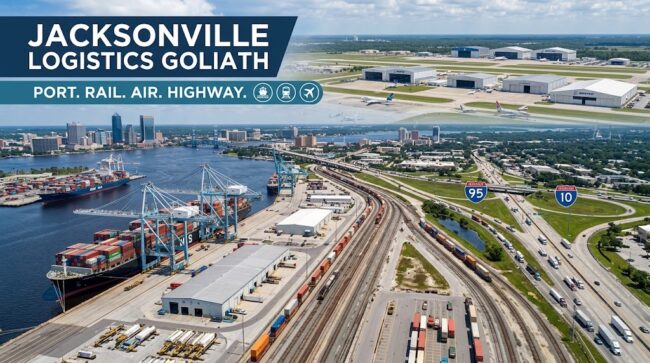
Jacksonville is not just a city; it is a critical nexus in the American supply chain. With three major interstates—I-95, I-10, and I-75—intersecting here, alongside two deep-water ports and world-class rail connectivity, Jacksonville is the heartbeat of Florida’s logistics industry.
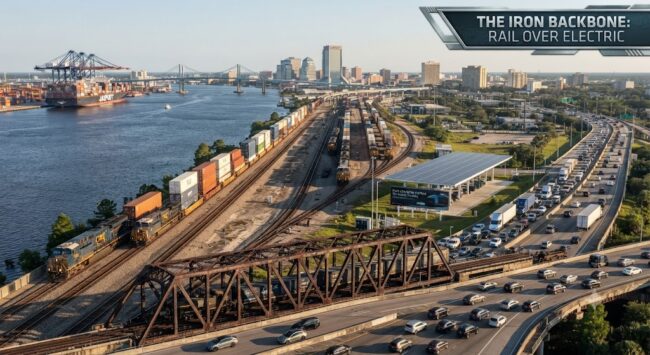
Yet, as the city grows, its highways are choking. We are currently pouring billions into road expansion, a “more lanes, more problems” approach that only serves to induce more congestion. The current narrative suggests that if we just replace the diesel trucks stuck in gridlock on I-95 with electric ones, our problems will vanish. This is not just optimistic; it is fundamentally flawed. Electric trucks do not solve congestion; they do not solve the wear and tear on our asphalt; and most importantly, they do not solve the physics of energy efficiency.
The Physics of Efficiency: Why Batteries Are Not the Answer
To understand why the electric semi-truck is a poor solution for long-haul freight, one must look at the constraints of physics. Batteries, no matter how advanced, are heavy. In the world of trucking, weight is the enemy of profit.
A heavy-duty electric semi requires a massive battery pack to achieve any semblance of a respectable range. That battery pack occupies space and, more crucially, consumes a massive amount of the truck’s legal weight allowance. Every ton dedicated to a lithium-ion battery is a ton of cargo that cannot be hauled. For a logistics hub like Jacksonville, where thousands of containers are offloaded at JAXPORT daily, efficiency is defined by volume and weight. A truck that requires a four-hour charging break and carries 20% less freight than its diesel counterpart is not a “solution”—it is a regression.
Compare this to rail. A single freight train, efficiently navigating the tracks already integrated into our port facilities, can move a ton of goods nearly 500 miles on a single gallon of fuel. It is three to four times more energy-efficient than a truck. While the “EV lobby” talks about zero tailpipe emissions, they conveniently ignore the massive ecological footprint of mining the lithium, cobalt, and nickel required for those colossal battery packs—a footprint that is multiplied by the thousands for every electric fleet.
The Economic Mirage of EV Charging
The infrastructure required to support an electric trucking future is staggering. To keep an electric fleet moving along the I-10 corridor, we would need to install megawatt-level charging stations every few dozen miles. This isn’t just about plugging a truck into a wall; it requires a complete overhaul of the electrical grid, massive new substations, and a consistent, reliable energy supply that Florida’s grid—already stressed by heat waves and storm resilience needs—simply isn’t built to handle.
Who pays for this? The answer is inevitably the taxpayer. Meanwhile, the railroads that serve Jacksonville—CSX, Norfolk Southern, and the Florida East Coast Railway—operate as private, self-sustaining entities. They build, maintain, and upgrade their own tracks, bridges, and yards with private capital. They are not waiting for a government handout to “electrify” or upgrade their capacity; they are doing it because it makes business sense.
Investing in rail is an investment in an existing, proven engine of growth. Expanding the capacity of Jacksonville’s intermodal facilities does more for the local economy than building charging lanes ever could. It creates high-paying, specialized jobs in logistics, engineering, and maintenance, rather than the temporary boom of a construction crew laying copper wiring for chargers.
The Reality of “Last Mile” vs. “Long Haul”
The most sophisticated logistics planners in the world know a simple truth: rail is for the long haul; trucks are for the last mile.
Jacksonville has a unique advantage: it is the end of the line for much of the nation’s freight and the beginning of the distribution chain for the rest of Florida. By moving the heavy, long-distance haulage from the interstate to the rail line, we could eliminate tens of thousands of truck trips per month.
Imagine a system where goods arrive at JAXPORT, are loaded directly onto a train, and are whisked to centralized distribution hubs in Orlando or Miami, leaving the highways free for local deliveries and passenger traffic. This is not a futuristic dream; it is an existing model that we are failing to scale. Instead, we are distracted by the shiny, high-tech PR of electric semis. We are debating the color of the paint on the truck while the engine of our economy—the rail network—is being underutilized.
Why the “Tesla Semi” Narrative Fails
The marketing machine behind the electric semi-truck is masterful. It plays on our desire for a clean, tech-forward future. But let’s look at the reality. A truck’s primary job is to provide utility—to move as much as possible, as cheaply as possible, as reliably as possible.
The electric semi fails this test. Between the downtime required for charging, the loss of cargo capacity due to battery weight, and the astronomical upfront costs of the vehicles themselves, the electric semi is a luxury experiment masquerading as a logistical savior. It is perfect for a short-haul drayage run from the port to a warehouse three miles away, but it is a disastrous choice for the interstate.
When a diesel truck breaks down, it can be repaired by almost any shop in Jacksonville. When an electric semi-truck’s proprietary, high-tech drivetrain fails, the supply chain grinds to a halt. We are replacing a robust, proven system with a fragile, over-engineered one.
The Path Forward for Jacksonville
So, what should Jacksonville do?
- Prioritize Rail Integration: The city should focus its economic development efforts on incentivizing companies to utilize rail for regional transit. Port-to-warehouse connectivity should be the primary focus of all infrastructure grants.
- Stop Inducing Demand: Every dollar spent on “smart highways” for electric charging should be redirected to track maintenance and intermodal yard expansion. We do not need more pavement; we need more iron.
- Modernize the Existing Network: While we don’t need to replace diesel with batteries, we can look into cleaner locomotive technologies like hydrogen fuel cells or advanced diesel hybrids for switching operations. The rail industry is already doing this, and they are doing it at scale.
Jacksonville has the potential to lead the nation in efficient, sustainable logistics. We can be the city that realized the “Green” solution wasn’t just about swapping one type of engine for another, but about optimizing the way we move our world.
The electric semi-truck is a toy for billionaires and a distraction for policy-makers. The steel rail is the backbone of the American dream, the engine of the industrial age, and the unsung hero of our future. It’s time we stopped looking at the highway and started looking at the tracks. If Jacksonville wants to stay the logistics capital of Florida, it needs to get back on track—literally.
The Scale of the Challenge: Moving Beyond the Hype
To truly appreciate why rail wins, one has to look at the numbers of the “logistics chain.” In a city like Jacksonville, the throughput of goods is measured in millions of tons per year. If you attempt to transition that flow to electric trucks, you are essentially trying to solve a bottleneck by adding more bottlenecks.
Consider the “Megawatt Charging” problem. A single high-speed charger for a semi-truck requires a power load equivalent to a small apartment complex. Now, multiply that by the hundreds of trucks that pull into a major regional distribution center every night. The electrical infrastructure required to support this would necessitate massive upgrades to local utility grids that could take decades and billions of dollars.
In contrast, rail yards are already massive energy hubs, but they are built to optimize flow, not just power consumption. They use gravity, high-torque locomotive engines, and sophisticated scheduling software to move more weight with less energy than any electric vehicle could ever hope to manage.
The Myth of “Zero Emission”
The narrative of the electric semi is deeply tied to the “zero-emission” marketing label. It is a feel-good phrase that ignores the entire lifecycle of the vehicle. A truck’s “carbon cost” isn’t just what comes out of the tailpipe—it’s the mining of the materials for the battery, the manufacturing of the truck, the infrastructure to support it, and the energy mix of the power grid it plugs into.
In Florida, where our energy grid is still transitioning, an electric truck is only as “clean” as the coal or natural gas plant powering the grid. Meanwhile, freight railroads are continuously optimizing their existing, highly efficient diesel-electric engines. They are already at the peak of thermodynamic efficiency. If we want a greener future, we should be looking at how we can shift more freight to rail, which is a proven way to cut emissions by over 70% per ton-mile.
The Job Creator
There is a pervasive fear that moving to rail will hurt the economy. The opposite is true. Freight rail is a cornerstone of the middle class. Rail jobs are high-skilled, unionized, and come with benefits that trucking companies, with their high turnover rates and precarious labor models, struggle to match.
By investing in rail, Jacksonville isn’t just moving boxes; it’s moving people into better lives. We are building an industrial corridor that can support manufacturing, warehousing, and tech-sector logistics. We are creating a stable, long-term foundation for the city’s economy.
Final Thoughts: The Choice Is Ours
We are at a crossroads. We can continue to buy into the hype, pouring our tax dollars into a highway system designed for a 1950s era of trucking, now cluttered with “high-tech” electric vehicles that fail to solve the fundamental problems of cost, capacity, and infrastructure.
Or, we can embrace our identity as a logistics powerhouse and double down on the infrastructure that actually works. We can be a city that understands the difference between marketing and reality. We can be a city that chooses the efficiency of the iron horse over the fragility of the electric dream.
Jacksonville is the Gateway to Florida. Let’s make sure that gateway is paved with steel, not just empty promises and expensive batteries. The future of freight isn’t electric—it’s efficient. And in the world of logistics, efficiency has a name: Rail.
About the Author