The commercial real estate landscape of Jacksonville, Florida, is undergoing an unprecedented structural evolution. Long perceived as a sprawling, secondary market defined by logistical infrastructure and stable, horizontal expansion, Florida’s northernmost metro area is transforming into a dense, institutional-grade economy. This transition is propelled by a $7 billion downtown development pipeline, an immense influx of out-of-state institutional corporate capital, and a highly nuanced macroeconomic environment driven by volatile interest rate structures.
For decades, investment strategies focused heavily on South and Central Florida, allowing Jacksonville to sit on the horizon as a sleeping giant. Today, that giant is awake. As primary markets hit peak saturation and cost-prohibitive entry barriers, regional developers and institutional syndicates are repositioning capital into Northeast Florida. However, this massive growth wave must simultaneously navigate a challenging lending environment, where shifting interest rates have altered underwriting models and disrupted traditional multi-family development pipelines.
The $7 Billion Downtown Pipeline and Regional Anchors
The physical restructuring of Jacksonville is most visible across its urban core and waterfront districts. According to data from the Downtown Investment Authority (DIA) and Business Improvement Districts, the city’s active and proposed urban pipeline has climbed past the $7 billion threshold. This represents a monumental shift away from historical false starts and unfulfilled master plans toward fully capitalized, vertical execution.
The Stadium of the Future and the Sports & Entertainment District
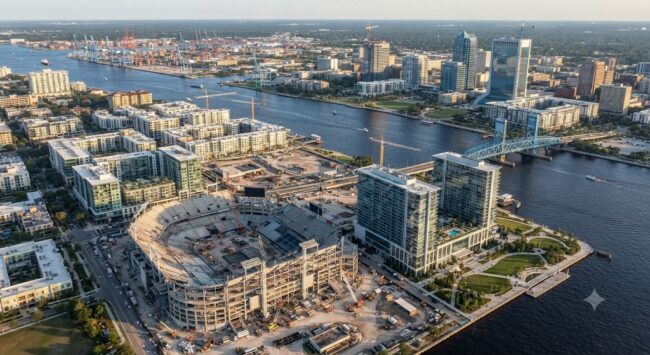
At the center of Jacksonville’s identity transformation is the $1.4 billion “Stadium of the Future” renovation, a joint venture between the City of Jacksonville and the Jacksonville Jaguars ownership group led by Shahid Khan. This massive public-private partnership extends far beyond a sports arena renovation; it acts as an economic anchor for the entire Northbank waterfront.
To facilitate the construction and modern structural overhauls, the Jaguars will play their 2027 season in Orlando. This temporary displacement underscores the sheer scale of the engineering feat taking place on the banks of the St. Johns River. The state-of-the-art facility will feature an open-air canopy designed specifically for optimal thermodynamics and heat reflection, transformed concourses, and a massive park network. The stadium project has triggered secondary investments throughout the Sports and Entertainment District, directly accelerating adjacent mixed-use spaces, commercial hospitality assets, and public infrastructure upgrades designed to handle millions of annual out-of-state visitors.
Shipyards and the Four Seasons Hotel & Residences
Directly adjacent to the sports complex is the $387.6 million Shipyards project, which includes a luxury Four Seasons Hotel and Residences and an ultra-modern office tower, One Tower Court. This project, heavily backed by Jaguars ownership, brings a premier, five-star hospitality and luxury residential flag to Northeast Florida for the first time. The development fills a historical void in Jacksonville’s corporate hospitality scene, offering high-net-worth individuals and corporate executives a dedicated luxury hub. By introducing top-tier residential units and office space right on the riverfront, the Shipyards project is fundamentally elevating the city’s average rent profiles and commercial property valuations.
Pearl Square and the Gateway Jax Master Plan
Moving into the core of downtown, the $500 million first phase of Pearl Square, spearheaded by the development firm Gateway Jax, represents one of the largest transit-oriented, urban infill projects in the Southeastern United States. Spanning multiple continuous blocks, this mega-development aims to transform the historic but underutilized urban grid into a vibrant, walkable, 18-hour destination.
A major milestone within the Pearl Square initiative is the adaptive reuse and transformation of the historic Ambassador Hotel into a Marriott Lifestyle Hotel, coupled with the introduction of high-end culinary concepts like Colletta Restaurant. Gateway Jax is creating thousands of square feet of ground-floor retail, wide walkable greenways, and high-density residential towers. This project bridges the gap between the downtown business core and the surrounding medical and educational campuses, establishing the critical mass required for true urban livability.
RiversEdge: The Southbank Transformation
On the opposite side of the river, the $693 million RiversEdge development is actively rewriting the Southbank skyline. Historically home to industrial plots and surface parking lots, this massive riverfront canvas is being transformed into a master-planned community. Homebuilding giant Toll Brothers has launched luxury townhome collections within the development, targeting affluent professionals and empty-nesters drawn to urban riverfront density.
RiversEdge seamlessly integrates public and private spaces, featuring over four acres of world-class public parks, a continuous extension of the Southbank Riverwalk, and dedicated boardwalks. The development also sets the stage for the highly anticipated relocation of the Museum of Science & History (MOSH) to the Southbank, where demolition and preliminary site preparations have commenced, further reinforcing the district’s status as a cultural and residential epicenter.
Brooklyn and the Northbank Riverfront
The rapid development of the Brooklyn submarket serves as a blueprint for Jacksonville’s current urban infill strategy. The $250 million One Riverside project, occupying the former Jacksonville Times-Union site, stands as a prime example of high-density mixed-use execution. Integrating a Whole Foods Market anchor with luxury multi-family units and restaurant concepts, One Riverside bridges the gap between urban living and core retail needs.
Crucially, this development interfaces with the ecological restoration of McCoy’s Creek. The city is investing millions into a one-mile shared-use path, pedestrian bridges, and natural flood mitigation networks along the creek, proving that modern urban density in Jacksonville is deeply tied to resilient, green infrastructure.
The Influx of Out-of-State Corporate Capital
Jacksonville’s development boom is no longer funded solely by local financial institutions and regional syndicates. The market has caught the attention of global private equity firms, national real estate investment trusts (REITs), and institutional sovereign funds. Out-of-state corporate capital is flooding the market, driven by favorable tax climates, robust population growth, and a diversified economic foundation that insulates the region from sector-specific downturns.
The Migration of Institutional Heavyweights
A defining signal of Jacksonville’s market maturation is the arrival of ultra-high-profile South Florida and national entities like Related Group. Known for developing iconic luxury high-rises in Miami and Fort Lauderdale, Related’s heavy capital deployment in Jacksonville indicates that institutional players view Northeast Florida as a high-yield market with significant upside.
This influx of corporate capital targets not only trophy urban properties but also suburban commercial footprints, medical retail along Gate Parkway, and elite golf community redesigns, such as the Glen Kernan Golf Course and Country Club transformation led by Corner Lot alongside sports legends Jim Furyk and Cameron Smith.
National developers are buying up massive land parcels because the yield profiles in Jacksonville remain highly competitive compared to primary markets. The city represents roughly 0.5% of the total United States population, yet industry data from major brokerages indicates it accounted for more than 5% of the entire country’s net retail and commercial space absorption over recent cycles. This dramatic outperformance highlights the rapid velocity at which out-of-state capital is being deployed and absorbed.
Industrial and Logistical Capital Supercycles
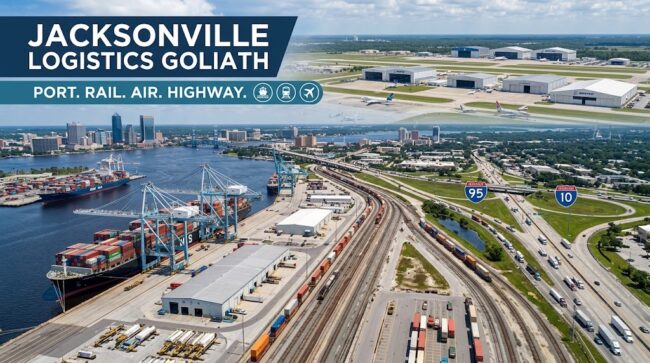
While downtown captures headlines, Jacksonville’s industrial corridor remains a primary draw for institutional capital. JAXPORT’s deep-water port infrastructure, combined with direct access to three major interstate highways (I-95, I-10, and I-75) and a robust rail network, has turned the region into an industrial powerhouse.
International logistics funds, sovereign wealth portfolios, and domestic industrial REITs have poured billions into speculative and build-to-suit distribution hubs across the Northside and Westside submarkets. Although the rapid delivery of industrial space pushed overall vacancy rates up to 10.6% by the end of Q1 2026, real estate groups like Colliers note that the construction pipeline is clearing rapidly. With no major speculative deliveries scheduled for the latter half of 2026, the industrial sector is shifting smoothly from oversupply into an absorption phase, supported by long-term corporate leases signed by global e-commerce, manufacturing, and distribution tenants.
The Macroeconomic Catalyst: Jobs, Eds, and Meds
Corporate capital is following the people. Northeast Florida is experiencing a massive wave of domestic in-migration, attracting skilled professionals from the Northeast, Midwest, and Southern California. Jacksonville’s economy is exceptionally diversified, grounded in financial technology, healthcare, aviation, biomedical engineering, and higher education.
The presence of institutional employers like Mayo Clinic, Baptist Health, Ascension St. Vincent’s, and the continuous expansion of corporate campuses for Dun & Bradstreet, FIS, and VyStar Credit Union provide a highly stable employment base. Mayo Clinic’s multi-million-dollar campus expansions in Jacksonville have created a regional biotech and medical tourism hub, which in turn draws ancillary real estate investments in medical offices, extended-stay hospitality, and high-end residential housing.
Shifting Interest Rates and Multi-Family Alterations
The surge in population and corporate interest has made multi-family real estate a highly active asset class in Jacksonville. However, this sector has felt the direct impact of shifting Federal Reserve monetary policies. The rapid transition from near-zero interest rates to an extended high-rate environment, followed by gradual rate cuts, has altered underwriting standards, reshaped developer strategies, and completely shifted the supply-and-demand dynamics of the apartment market.
The Underwriting Squeeze and Caps on Leverage
When the Federal Reserve held the federal funds rate at historical highs to combat structural inflation, the cost of capital for multi-family projects increased significantly. Debt service coverage ratios (DSCR) tightened dramatically. Projects that underwrote perfectly at a 3.5% or 4.0% interest rate became non-viable when permanent and construction lending rates spiked into the 6.5% to 8.0% range.
Multi-family loan indices for the Jacksonville market highlight the scale of this capital shift:
| Loan Type | Current Interest Rate Range | Maximum Loan-to-Value (LTV) | Typical Amortization |
| Fannie Mae DUS / Freddie Mac | 5.89% – 7.99% | 75% – 80% | Up to 30 Years |
| HUD 221(d)(4) Construction | 5.74% – 6.24% | 80% – 85% | Up to 43 Years (Fixed) |
| Commercial Bridge Loans | 4.61% – 13.61% | Variable (Asset Dependent) | 1 – 2 Years (Interest Only) |
| Life Insurance Companies | 5.70% – 5.90% | 65% – 70% | 15 – 30 Years |
This interest rate environment fundamentally changed how capital stacks are structured. Institutional developers who previously relied on high-leverage senior debt at 80% Loan-to-Value (LTV) were forced to recalibrate, as lenders dropped maximum LTV parameters to 65% or 70% to safeguard debt coverage. To close the resulting capital gaps, developers have had to inject significantly more cash equity or turn to expensive mezzanine financing and preferred equity structures costing anywhere from 14% to 15.5%. This added expense has completely changed the yield metrics for new projects.
The Tipping Point: Over-Supply to Near-Term Absorption
Despite the financing challenges of recent years, a massive wave of multi-family completions initiated during the low-rate environment of 2021 and 2022 hit the Jacksonville market over the past 12 to 18 months. In 2025 alone, downtown and its surrounding submarkets saw major completions, including Artea on the Southbank, the initial multi-family phases of One Riverside in Brooklyn, the extensive adaptive reuse of the Union Terminal Warehouse in the Sports and Entertainment District, the Lofts at Cathedral, and Johnson Commons in LaVilla.
This supply surge is projected to deliver roughly 3,500 units over the full course of 2026, representing a 2.3% inventory growth rate. This velocity ranks Jacksonville as the sixth-fastest growing major apartment market in the United States by percentage of inventory added. Because this influx of new units arrived just as macroeconomic job growth began to moderate, the market has seen temporary upward pressure on vacancy rates. Jacksonville’s overall apartment vacancy is expected to settle near 6.7% by the end of 2026, marking one of the higher vacancy profiles among major U.S. metros.
This temporary supply-and-demand mismatch has caused asking rent growth to flatten, hovering at a minor 0.2% year-over-year decline with average market rents settling at $1,492 per unit. To maintain occupancy and capture moving tenants, landlords of newly delivered Class-A buildings have had to offer significant concessions, such as one to two months of free rent or waived administrative fees.
The Supply Drop-Off and the Extended Outlook
While the current delivery of units creates an environment favoring tenants, a major market shift is occurring just under the surface. The high interest rates of the past 24 months effectively stopped new project starts. Construction starts for major multi-family projects fell sharply as capital costs surged.
Consequently, real estate analysts track a clear turning point following the third quarter of 2026. Once the current delivery cycle clears, the volume of ongoing construction activity will drop off sharply. Because Jacksonville’s fundamental population growth and net migration remain very strong, the market is positioned for a rapid absorption cycle throughout 2027 and 2028. Institutional investors who can weather the near-term concession environment are poised to capitalize on a highly restricted supply pipeline over the next 24 to 36 months, which will likely trigger a strong resumption of rent growth.
The 10,000-Resident Milestone
For long-term rental property syndicates and turnkey investment institutions, like JWB Real Estate Capital, the current real estate cycle presents a highly compelling entry point rather than a reason for caution. The multi-family boom has brought downtown Jacksonville to the edge of a critical socioeconomic tipping point: the 10,000-resident threshold.
Urban planning data consistently shows that when an urban core reaches 10,000 permanent residents, the local economy undergoes a structural shift. This density naturally attracts organic commercial retail, essential services, everyday grocery options, boutique entertainment, and an active night economy without requiring public subsidies. Reaching 9,228 residents recently—a 20.5% single-year surge and a near 97% increase since 2016—proves that Jacksonville is on the verge of becoming a true 18-hour self-sustaining urban center.
The Path Forward: A Balanced, Institutional Era
The story of the Jacksonville marketplace is one of transition from a mid-tier regional hub to a sophisticated, institutional-grade metro economy. The combination of multi-billion-dollar anchor projects like the Stadium of the Future, the Shipyards, Pearl Square, and RiversEdge is fundamentally reshaping the physical layout and economic potential of the city.
The flood of out-of-state corporate capital confirms that national investment groups view Jacksonville not as a short-term trend, but as a core growth asset backed by strong demographics and a highly diversified economy. While shifting interest rates have introduced challenges—forcing developers to adjust underwriting models, accept lower leverage, and navigate a temporary supply wave—the broader trend remains overwhelmingly positive.
As the construction pipeline slows down in late 2026 and the market absorbs its new inventory, Jacksonville is moving toward a highly balanced real estate environment. The near-term softening of rents and elevated vacancy rates represent a standard macroeconomic stabilization phase rather than a structural decline. For corporate investors, institutional developers, and businesses watching closely, the city no longer represents a speculative future conversation. Backed by capital, cranes, and clear demographic momentum, Jacksonville’s transformation is happening right now.
Resources and Contributing Research
- City of Jacksonville (Jacksonville.gov): Public Works Engineering and Capital Improvement Project Bid Forecast Data (2026-Q3 to 2027-Q2).
- Downtown Investment Authority (DIA): State of Downtown Annual Reports, official pipeline project registers, and Board meeting disclosures regarding public-private partnerships.
- Cushman & Wakefield: Jacksonville MarketBeat Research Reports, focusing on industrial vacancy metrics, retail asking rents, and multi-family performance indicators.
- Colliers International: Commercial Industry Outlook Snapshots for Northeast Florida, highlighting industrial absorption points and retail pre-leasing metrics.
- Avison Young & NAI Hallmark: Regional commercial real estate analytics covering office market tenant space negotiations and lease renewal statistics.
- Select Commercial Funding & Apartment Loan Store: Northeast Florida multi-family underwriting guides, historical index tracking for Fannie Mae, Freddie Mac, HUD 221(d)(4) loans, and prevailing asset class interest rate ranges.
- Downtown Vision Inc.: Urban core resident tracking metrics, tracking population growth trajectories toward the 10,000-resident threshold.
About the Author