April 27, 2026
CSX: The Jacksonville Giant Quietly Moving America
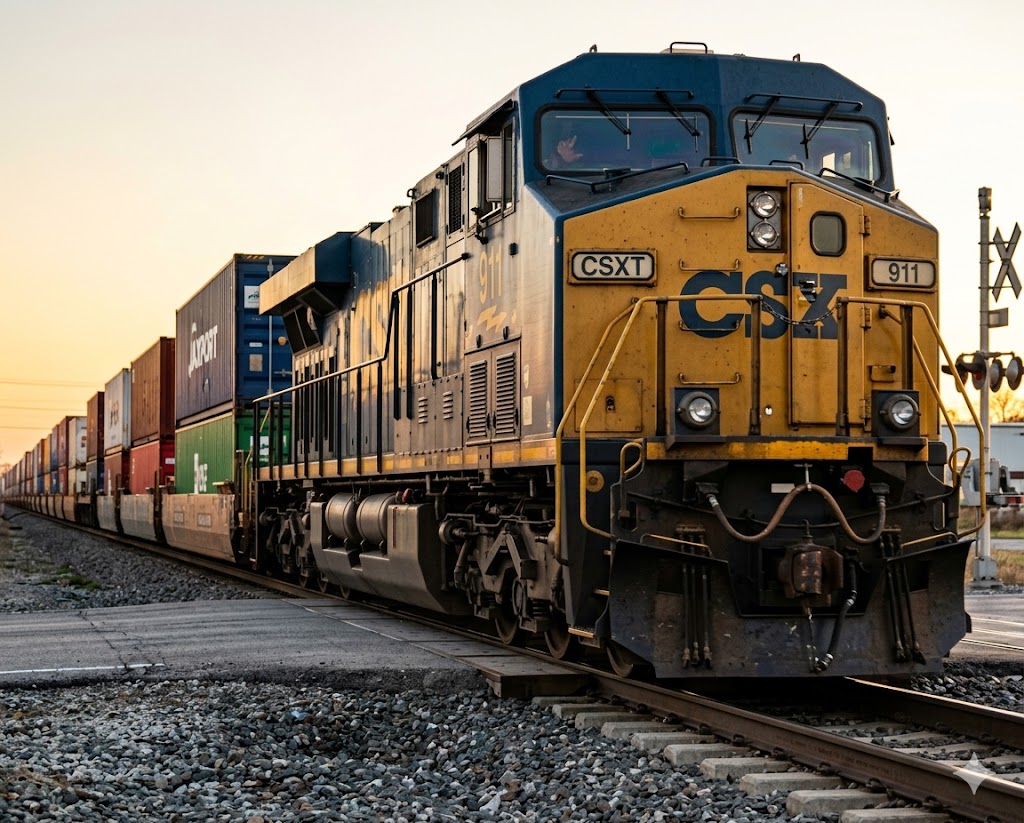
If you’ve ever stood at a railroad crossing in the Eastern United States and watched a mile-long freight train rumble past, there’s roughly a 50/50 chance you were looking at a CSX train. Maybe higher.
The locomotives are dark blue and yellow. The reporting marks read CSXT. The cars carry everything from Toyota engines to Iowa corn to Florida orange juice to Pennsylvania steel to Christmas presents from China. And the company orchestrating that whole moving symphony — across 20,000 miles of rail, 26 states, two Canadian provinces, 70+ ocean and river ports, and 240+ short-line railroads — is headquartered right here in Florida.
In Jacksonville, to be exact. 500 Water Street, 15th Floor. Right on the banks of the St. Johns River.
CSX is one of the most important companies almost no Floridian thinks about on a daily basis. It’s a Fortune 500 powerhouse, a critical pillar of American supply chains, the largest private employer in Northeast Florida outside of the military and healthcare, and one of only four major Class I freight railroads still operating in the United States.
So let’s give CSX the spotlight it deserves. Where it came from. How it ended up in Jacksonville. Why “nothing stops this train” is more than a tagline. And what every Florida business owner should understand about the company that quietly moves the economy through their backyard every single day.
The Origin Story: 190+ Years of Track, Steam, and Mergers
CSX is technically a young company. Born in 1980. But its DNA is much, much older.
The corporation is the descendant of nearly two centuries of American railroad history — the rolled-up, merged-together, and rebranded successor to dozens of legendary railroads with names like the Baltimore & Ohio (B&O), the Chesapeake & Ohio (C&O), the Seaboard Coast Line, the Atlantic Coast Line, the Louisville & Nashville, and the Clinchfield.
The B&O alone dates back to 1827, making it America’s first common-carrier railroad. Some of the very tracks CSX trains run on today were laid before the U.S. Civil War. That’s not marketing fluff — that’s a literal piece of national infrastructure operating continuously, evolving across nearly 200 years of American economic history.
In 1980, the modern company was created when Chessie System (which already combined the B&O and the C&O) merged with Seaboard Coast Line Industries to form CSX Corporation. The original co-CEOs — Hays Watkins and Prime Osborn — famously coined the name “CSX” together, where the “C” stood for Chessie, the “S” stood for Seaboard, and the “X” was deliberately left to mean “unknown” or “anything more we add later.”
Think about how confident a leadership team has to be to pick a name where one of the three letters means “and whatever comes next.” That’s the spirit of this company.
How CSX Ended Up in Jacksonville
CSX wasn’t always headquartered in Florida. After the 1980 merger, the corporate offices were based in Richmond, Virginia. But the operating arm — what would become CSX Transportation — had been in Jacksonville since the 1950s, when the Atlantic Coast Line Railroad chose the city as its new headquarters over Savannah and Charleston in 1956. (Imagine being on that pitch committee. Jacksonville won.)
The iconic CSX Transportation Building at 500 Water Street was completed in 1960, originally for the Atlantic Coast Line, and has served as the operating headquarters ever since.
In 2003, then-CEO Michael Ward made the bold call to consolidate the entire corporation in Jacksonville, moving the parent CSX Corporation headquarters from Richmond down to Florida. The decision permanently cemented Jacksonville as one of America’s true railroad capitals — and gave Florida one of its largest publicly traded headquarters.
Today, that 251-foot-tall riverside high-rise is one of the most recognizable buildings in the Jacksonville skyline, with the iconic blue CSX logo gleaming above the St. Johns River.
Brian’s Take: CSX’s Jacksonville Move Is the Best Florida Business Decision Almost Nobody Talks About.
Pulling a Fortune 500 corporate HQ from Virginia down to Jacksonville in 2003 looked unsexy at the time, but it injected billions of dollars in payroll, real estate, and tax revenue into Northeast Florida and helped catalyze the entire Jacksonville logistics renaissance that followed. The lesson for every Florida entrepreneur: bet on the boring fundamentals — geography, infrastructure, taxes — and the flashy growth eventually shows up on its own.
— Brian
The Network: What “20,000 Route Miles” Actually Means
It is genuinely hard to wrap your head around the scale of CSX’s operating network without a map and a strong cup of coffee. Let’s try anyway.
- Approximately 20,000 route-miles of track. For perspective, that’s roughly the distance you’d travel circling the entire planet’s equator — not “metaphorically,” literally.
- Operations across 26 states east of the Mississippi River, plus the District of Columbia and the Canadian provinces of Ontario and Quebec.
- Direct connections to more than 240 short-line railroads. (Short-lines are the smaller regional railroads that feed cargo into Class I networks like CSX.)
- Linkages to 70+ ocean, river, and lake port terminals.
- Service to roughly two-thirds of the entire U.S. population, who live in the eastern half of the country.
- Around 23,000 employees, of whom roughly 16,900 are unionized rail labor.
And what does CSX move? Almost everything that builds, feeds, and powers the country:
- Merchandise: chemicals, agricultural products, food and consumer goods, metals, forest products, fertilizer, minerals.
- Intermodal: containers and trailers transferred between ships, trucks, and rail — the fastest-growing segment in modern railroading.
- Coal: still a major (though declining) commodity, particularly thermal coal for utilities and metallurgical coal for steel production.
- Automotive: finished vehicles and auto parts, including major flows for Ford, GM, Toyota, Honda, and others.
In 2025, CSX generated full-year revenue in the $14 billion+ range with operating income consistently among the strongest in the industry. The first quarter of 2026 alone saw operating income of $1.25 billion and net earnings of $807 million, with a 36% operating margin — the kind of profitability that Wall Street routinely cites as evidence that well-run railroads remain among the most resilient businesses in the entire U.S. economy.
The Magic of Intermodal
If there’s one segment of CSX’s business that every Florida operator should understand, it’s intermodal. This is the practice of moving sealed shipping containers — the same ones you see on container ships — directly off the dock, onto rail flatcars, and inland to distribution hubs.
CSX is one of the country’s largest intermodal players, and intermodal is the connective tissue that links JAXPORT, the Port of Charleston, the Port of Savannah, the Port of Baltimore, and the Port of New York/New Jersey to inland markets like Atlanta, Charlotte, Memphis, Cincinnati, Chicago, Pittsburgh, and Detroit.
Every time you order something from Amazon that “shipped from China” but somehow showed up at your house in two days, an intermodal network like CSX’s is part of the reason. Fast, efficient, and dramatically cheaper and lower-emissions than long-haul trucking.
The Big Reset: Precision Scheduled Railroading and the 2017 Earthquake
Even a 200-year-old railroad has to evolve, and CSX’s most dramatic transformation came in 2017, when an activist hedge fund called Mantle Ridge — holding 4.9% of the company — forced one of the most consequential leadership changes in modern corporate America.
The hedge fund demanded the legendary railroad turnaround artist E. Hunter Harrison be installed as CEO. Harrison had already run Illinois Central, Canadian National, and Canadian Pacific, transforming each one with his now-famous Precision Scheduled Railroading (PSR) philosophy.
CSX paid Harrison roughly $300 million to leave Canadian Pacific and lead them. Yes, $300 million.
Harrison’s PSR doctrine was simple but ruthless:
- Run trains on a fixed schedule, not when they “fill up.”
- Operate fewer, longer trains to dramatically improve asset utilization.
- Cut headcount, cut equipment, cut middle management — relentlessly.
- Reward speed and reliability above all else.
It worked on the financials. CSX’s operating margins improved meaningfully and shareholder returns soared. But the transition was brutal. Within months, 4,000 employees were let go, nearly 1,000 pieces of equipment were mothballed, customers complained about service disruptions, and morale cratered.
And then, in a turn no script could have predicted, Harrison died on December 16, 2017 — just two days after taking medical leave. His handpicked successor James Foote took over, continuing PSR but with a steadier, more customer-focused hand.
In September 2022, Foote retired and was succeeded by Joseph Hinrichs, a longtime Ford Motor Company executive who has since refocused CSX on safety, customer service, and rebuilding worker trust — even while preserving most of the operational efficiencies PSR introduced. In September 2025, Steve Angel was appointed President and CEO, marking the latest chapter in CSX’s leadership evolution.
Brian’s Take: CSX’s PSR Story Is a Case Study Every Florida CEO Should Read.
The financial wins of Precision Scheduled Railroading were real, but so was the hidden cost — torched morale, frustrated customers, and brand damage that took years to repair. Whenever you hear a consultant promise huge cost savings through “efficiency,” ask yourself what you’re trading away that won’t show up on a quarterly earnings report.
— Brian
Why Nothing Stops This Train: The Resilience Story
A favorite CSX internal slogan is “Nothing stops this train.” After spending some time digging through the company’s modern history, you start to understand why it stuck.
In just the last few years, CSX has navigated:
- A global pandemic that simultaneously crashed and re-exploded every cargo category they move.
- The 2022 supply chain crisis, where every port in America was clogged.
- A near-strike of national rail labor in late 2022 that was averted only at the last minute by Congressional intervention.
- Hurricane Helene in 2024, which catastrophically flooded 60 miles of CSX’s Blue Ridge Subdivision — one of the most rugged, hard-to-rebuild rail corridors in the East. CSX restored full service in less than a year.
- A historic $450 million expansion of Baltimore’s Howard Street Tunnel, completed in 2025, which finally cleared a long-standing rail bottleneck on the I-95 corridor and will enable double-stack intermodal service through Baltimore once the remaining clearance work is finished in early 2026.
- The 75th Street CREATE Flyover in Chicago, eliminating one of the worst chokepoints in the entire U.S. rail network.
- A 24% improvement in personal injury frequency and 13% improvement in train accident rate between 2024 and 2025.
- Deployment of new Mobile Collision Safety systems and expanded use of autonomous electric shuttles at select terminals — early signs of the next technology wave coming to railroading.
The lesson isn’t that nothing ever goes wrong. The lesson is that this company, this network, this workforce, has been hit by everything and still keeps the trains rolling.
CSX’s Jacksonville Footprint and Local Impact
CSX’s economic impact on Northeast Florida is genuinely massive. While the company doesn’t always disclose precise local headcount, here’s what we can responsibly piece together:
- Approximately 23,000 total employees, with one of the largest concentrations based at and around the Jacksonville headquarters.
- The 500 Water Street headquarters anchors downtown Jacksonville’s Northbank, employing executive, finance, legal, IT, customer service, network operations, and engineering staff.
- A massive CSX Technology operations center further south on the Southside.
- Major rail yards and intermodal facilities scattered across the region, including the strategically vital connections feeding directly into JAXPORT.
- A long history of major philanthropic giving in the Jacksonville community, including support for downtown revitalization, education, public safety, and youth programs.
When CSX moved its full corporate HQ to Jacksonville in 2003, it brought with it hundreds of high-paying executive and professional jobs that have stayed and multiplied. The company has been a bedrock institutional citizen of downtown Jacksonville for over two decades.
Brian’s Take: Florida Businesses That Understand Rail Are Quietly Beating the Ones That Don’t.
Almost every Florida operator I know shipping goods up the East Coast is over-relying on trucking — paying premium rates, fighting driver shortages, and absorbing fuel volatility — when CSX intermodal could move the same freight cheaper, more reliably, and with a fraction of the carbon footprint. If your business ships more than a few truckloads a month, your next phone call should be to a freight broker who can run the rail math against your trucking costs.
— Brian
What Every Florida Business Owner Should Know About CSX
You don’t need to be a logistics professional to extract value from understanding what CSX is doing. Here are the takeaways that matter:
- Rail is not dead. It’s quietly the most efficient freight mover in the country. A single freight train can replace several hundred trucks. As trucking gets harder and more expensive, rail’s economics keep getting better.
- Intermodal is the future. If your business moves enough volume, intermodal pricing through CSX (often via a third-party broker) is frequently cheaper and more reliable than long-haul trucking — especially for routes between Florida ports and inland Southeastern hubs.
- CSX feeds JAXPORT. Every container that flows through Jacksonville’s port has at least the option of being routed onto a CSX train within hours. The synergy between port and railroad is one of Jacksonville’s most underrated competitive advantages.
- Sustainability is a real selling point. Rail freight emits roughly 75% less carbon per ton-mile than trucking. Every ESG report your customers are asking for benefits when you can credibly say you ship by rail.
- Local real estate near rail yards is gold. Industrial parks and warehouse buildings with rail access are becoming some of the most valuable commercial real estate in the Southeast.
- CSX is a Florida company. When you’re a Florida operator and you can route freight through a Florida-headquartered Fortune 500 company that anchors your state’s largest port — that’s just good economic karma. Use it.
Looking Ahead: The Train Keeps Building
CSX isn’t slowing down. The Howard Street Tunnel expansion is wrapping up. New autonomous and AI-driven safety systems are rolling out across the network. Investments in double-stack intermodal capacity continue. The company has been quietly testing next-generation locomotive technology including battery-electric and hydrogen-fueled experiments. And the Jacksonville headquarters keeps growing in importance as the company’s strategic, financial, and operational nerve center.
Nearly two centuries since the first B&O train rolled out of Baltimore. More than 75 years since the Atlantic Coast Line picked Jacksonville as its home. More than 20 years since the parent corporation officially became a Florida company. And on any given day, you can stand on a Jacksonville bridge and watch a CSX train haul tens of thousands of tons of cargo through the heart of the city, on its way to feed an economy of more than 200 million Americans.
Nothing stops this train. Not pandemics, not hurricanes, not labor disputes, not management upheavals, not market cycles. The locomotives keep rolling, the tracks keep getting upgraded, the people keep showing up, and the commerce of the Eastern United States keeps moving — because Jacksonville’s quietest giant is doing its job.
If you’ve never given CSX a second thought, do yourself a favor next time you’re driving over a railroad crossing in Florida, Georgia, or anywhere east of the Mississippi. Roll the window down. Listen to the horn. Watch the cars roll past.
That’s the sound of America being built, fed, fueled, and shipped — courtesy of a Florida company quietly running one of the most important machines in the entire economy.
Resources & Further Reading
- CSX Corporate Website — The official source for company information, news, financials, and shipping services.
- CSX Investor Relations — Quarterly earnings, annual reports, SEC filings, and the latest on company strategy.
- CSX Newsroom — Press releases on infrastructure projects, leadership changes, and major operational announcements.
- Railway Age — The leading independent industry publication covering CSX, Class I railroads, and freight rail policy.
- Progressive Railroading — In-depth railroad business news, including detailed coverage of CSX’s quarterly performance and strategic initiatives.
About the Author