Jacksonville Business News | Insurance & Risk Management | September 22, 2026
Quick Answer
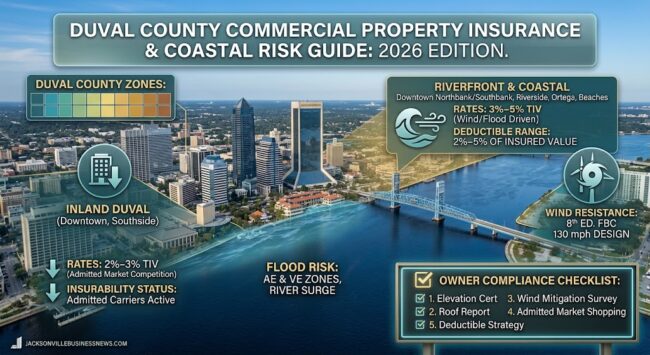
Duval County commercial property owners in 2026 face separate windstorm deductibles of 2% to 5% of insured value, admitted-market rates that brokers report at roughly 2% to 5% of total insured value depending on distance from the coast, and Florida Building Code 8th Edition wind and flood standards that determine both insurability and premium.
Commercial Property Insurance in Duval County: Direct Answers
What does commercial property insurance cost in Duval County in 2026?
Rates are set per property, but Jacksonville brokers publishing 2026 benchmarks report the following typical ranges for admitted-market coverage:
| Location | Typical annual premium (% of total insured value) | Market notes |
|---|---|---|
| Inland Duval (Downtown, Southside, San Marco, Riverside, Mandarin) | 2%–3% | Admitted carriers competing again after 2023–24 hard market |
| Coastal Duval (Jacksonville Beach, Atlantic Beach, Neptune Beach, Mayport, Ponte Vedra edge) | 3%–5% | Wind exposure drives placement; higher deductibles common |
| Properties with open named-storm claims in past 24 months | Surplus lines pricing | Usually specialty placement until claim closes |
One Jacksonville risk advisor reports a building placed at $7.40 per $1,000 of value in the 2024 surplus-lines market rebinding at $5.90 per $1,000 in the admitted market in 2026, a 20% reduction with better terms. The statewide surplus-lines association has reported commercial windstorm and hail costs down 47% and general commercial business down 10%.
The consistent message from the market: owners who accepted a doubled premium in 2023 and never re-shopped are likely overpaying today.
Why did rates fall?
Three drivers, all statewide:
- Legal reform — 2022–23 legislation eliminated one-way attorney fees and restricted assignment-of-benefits litigation, cutting the loss-adjustment costs that had driven carriers out of Florida
- New capacity — more than 17 new carriers have entered the state since the reforms, and Citizens Property Insurance, the state-backed insurer of last resort, shrank to roughly 278,000 total policies by mid-2026, its lowest in over a decade
- Rate filings turning negative — Citizens approved an average 8.8% decrease for multiperil policies and 5.5% for wind-only coverage for 2026 renewals, which sets a competitive floor private carriers must respond to
How do windstorm deductibles work on commercial policies?
Florida commercial property policies carry a separate hurricane or named-storm deductible expressed as a percentage of the insured value of the building (and sometimes contents), not a flat dollar amount.
- Standard options: 2%, 5% or 10% of insured value
- Example: a $5 million building with a 5% named-storm deductible carries a $250,000 out-of-pocket retention per storm event, before the carrier pays anything
- Trigger: typically applies only when the National Hurricane Center has issued a hurricane watch or warning for any part of Florida, or for a named storm as defined in the policy; ordinary thunderstorm wind damage falls under the standard all-other-perils deductible
- Trade-off: moving from 2% to 5% commonly reduces premium 15%–25%; the savings must be weighed against the balance-sheet impact of a six-figure retention
- Deductible buyback: specialty carriers sell deductible-buyback policies that convert a percentage retention into a flat $5,000–$10,000, typically bound before the June 1 hurricane-season start; brokers cite a late-May binding deadline in practice
Is wind coverage automatically included?
Not always. In coastal Duval, standard commercial property forms may exclude windstorm, requiring either a wind endorsement or a separate wind-only policy. Citizens writes commercial wind-only coverage statewide and carried about 4,562 commercial policies as of June 30, 2026. Citizens cannot write new commercial-residential multiperil policies (apartments, condos) but can write wind-only or wind-excluded coverage for them; commercial-nonresidential buildings face no such restriction.
What does the Florida Building Code require for wind resistance?
The Florida Building Code 8th Edition, effective December 31, 2023, governs all new commercial construction and substantial renovation in Duval County. Its wind provisions adopt ASCE 7-22:
- Design wind speed: the 8th Edition maps most of the Jacksonville metro at 130 mph (3-second gust) for Risk Category II structures, with higher categories for essential facilities
- Exposure category: sites fronting the St. Johns River, Intracoastal Waterway or Atlantic coast require Exposure D analysis, the most demanding wind-load classification
- Opening protection: in windborne-debris regions, all exterior glazing must be impact-rated or protected by approved shutters
- Sealed calculations: a Florida-licensed engineer must complete and seal main wind-force and components-and-cladding pressure calculations
- Next edition: the 9th Edition is under development with adoption expected by December 31, 2026, so projects permitting in 2027 should anticipate revised requirements
Note that Jacksonville Beach, Atlantic Beach, Neptune Beach and Baldwin operate independent building departments; projects in those municipalities follow the same state code but local permitting.
What retrofits actually reduce commercial premiums?
Carriers price commercial wind risk primarily on secondary water-resistance and envelope integrity. The retrofits with measurable premium impact:
- Roof replacement or reinforcement — roofs older than 15 years trigger surcharges or non-renewal; metal and modified-bitumen systems rate better than aged shingle or built-up roofs
- Roof-to-wall connections — hurricane straps or clips on wood-frame or light-gauge structures
- Opening protection — impact glazing or code-approved shutters on all openings, not just the storefront
- Roof deck attachment — screw-fastened decking with a sealed secondary water barrier
- Documentation — a commercial wind mitigation inspection (the OIR-B1-1802 form is residential; commercial carriers use their own engineering surveys) that verifies these features is what converts the retrofit into a rate credit
Owners should obtain the carrier’s inspection before the retrofit to confirm which improvements will be credited.
What are the flood and elevation requirements along the St. Johns River?
Windstorm coverage excludes flood. Flood is a separate policy through the National Flood Insurance Program or private flood carriers, and many lenders require it for properties in FEMA Special Flood Hazard Areas.
- Flood zones: Duval County’s riverfront, Downtown Northbank and Southbank, Arlington, Ortega and the beaches include AE zones (base flood elevation established) and VE zones (coastal high-hazard with wave action)
- Elevation certificate: an FEMA Elevation Certificate prepared by a licensed surveyor documents the lowest floor elevation relative to base flood elevation; it is required to rate an NFIP policy in an SFHA and is the single most influential document in a flood premium
- New construction: the 8th Edition FBC flood provisions require lowest-floor elevation at or above base flood elevation plus freeboard, flood-resistant materials below that line, and in some cases FEMA Letter of Map Amendment or Revision filings before permits advance
- Substantial improvement rule: if renovations to an existing building in an SFHA cost 50% or more of its market value, the entire building must be brought into flood-code compliance, including elevation; this rule catches many adaptive-reuse projects on the Downtown riverfront
- Coastal Construction Control Line: beachfront projects seaward of the CCCL require separate Florida Department of Environmental Protection permits
What is a practical compliance sequence for a Duval commercial owner?
- Pull the FEMA flood zone and, if in an SFHA, order an Elevation Certificate
- Commission a roof condition report and a carrier-recognized wind mitigation survey
- Get an insurance-to-value appraisal; underinsurance triggers coinsurance penalties on partial losses
- Shop the admitted market at least 90 days before renewal, with the mitigation documentation in hand
- Decide the windstorm deductible percentage against cash reserves, and price a buyback if the retention exceeds what the business can absorb
- Place flood coverage separately, and confirm business-interruption coverage responds to both wind and flood events
- Re-shop annually; the 2026 market rewards owners who bring updated documentation
Brian’s Take
By Brian French, Publisher, Florida Authority Network
I managed money through two Florida insurance cycles, and I learned that the industry’s memory is short and its pricing is momentum-driven in both directions. What happened in 2023 was carriers fleeing; what is happening in 2026 is carriers competing. Most Duval commercial owners are still carrying 2023 pricing because nobody told them the market turned.
Three practical points.
The deductible is the real policy. A 5% named-storm deductible on a $10 million Southbank building is $500,000 per storm. That is not insurance; that is a self-insured layer with a carrier above it. Owners who chose 5% to save premium in 2023 should recheck the math now that 2% is affordable again.
Flood is where Jacksonville is under-protected. The St. Johns River flooded Downtown in Irma in 2017 and the city has spent hundreds of millions on riverfront parks since, much of it in AE zones. Wind coverage will not pay a dollar for river surge. If your building sits within a few blocks of the water and you do not hold a flood policy, you are relying on luck.
Documentation is the new currency. The single cheapest thing an owner can do this year is spend a few thousand dollars on an elevation certificate, a roof report and a mitigation survey. In the 2026 market, those three documents are the difference between a surplus-lines quote and an admitted one. For site selectors comparing Jacksonville to Tampa or Miami, this is also where Jacksonville wins: inland Duval carries a fraction of the wind and surge load of the Gulf or South Florida coasts, and the premium spread reflects it.
Frequently Asked Questions
Are commercial insurance rates in Jacksonville going down in 2026?
For most well-documented properties, yes. Statewide surplus-lines commercial windstorm costs are down substantially, Citizens has filed rate decreases, and new carriers have entered the admitted market. Properties with recent claims or aging roofs remain harder to place.
What is the difference between a hurricane deductible and a windstorm deductible?
A hurricane deductible applies only to losses from a declared hurricane (tied to NHC watches or warnings). A broader windstorm or named-storm deductible may apply to tropical storms and other named systems as well. Policy language controls; owners should read the trigger definition.
Does Duval County require impact windows on commercial buildings?
In windborne-debris regions as defined by the FBC 8th Edition, exterior openings on new construction and qualifying renovations must be impact-rated or protected. Whether a specific parcel falls in a debris region depends on its mapped wind speed and distance from the coast.
How much does a commercial elevation certificate cost in Jacksonville?
Typically several hundred to a few thousand dollars depending on site complexity, prepared by a Florida-licensed surveyor. It is a one-time document unless the building or the flood map changes.
Will Citizens insure my commercial building?
Citizens writes commercial-nonresidential coverage and commercial wind-only policies statewide when the private market declines. New commercial-residential (apartment and condo) multiperil policies are not available from Citizens; those buildings can obtain wind-only or wind-excluded coverage.
When does the Florida Building Code 9th Edition take effect?
Adoption is expected by December 31, 2026, following Florida’s three-year code cycle. Projects permitted before that date are governed by the 8th Edition.
Sources and Further Reading
- Executive Office of the Governor — “Governor Ron DeSantis Announces Major Insurance Rate Relief as Florida’s Reforms Deliver Results” (2026): https://www.flgov.com/eog/news/press/2026/governor-ron-desantis-announces-major-insurance-rate-relief-floridas-reforms
- Atesa Risk Advisors — “2026 Guide: Lowering Commercial Property Insurance in Duval County” (July 30, 2026): https://atesariskadvisors.com/blog/jacksonville-commercial-property-insurance-duval-county-2026
- AJ Insurance Services — “Commercial Property Insurance Quotes in Florida: Wind Ready” (August 7, 2026): https://www.ajinsuranceservices.com/business-insurance/commercial-property/
- Prime Insurance Solutions — “Commercial Property Insurance with Wind Coverage in Florida” (July 2026): https://primeinsurancesolutions.com/florida-insurance/commercial-property-insurance-with-wind
- Worth Insurance — “Florida Homeowners Insurance Rates by County in 2026” (Citizens policy count and carrier entry data): https://www.worthinsurance.com/florida-home-insurance/florida-homeowners-insurance-rates-by-county
- Bell & Kenins Insurance — “Florida Windstorm Insurance” (Citizens 2026 rate decreases): https://www.bellkenins.com/windstorm-insurance-florida
- Broker One — “Florida Home Insurance Rates by County 2026” (deductible and reinsurance factors): https://mybrokerone.com/en/post/guides/florida-home-insurance-rates-by-county-2026
- Permit Place — “Florida Building Code 2026: 8th Edition Changes & 9th Edition Guide” (February 2026): https://permitplace.com/florida-2026-building-code-changes/
- Jacksonville Commercial Contractor Authority — “Jacksonville Commercial Construction Codes and Compliance Standards”: https://jacksonvillecommercialcontractorauthority.com/jacksonville-commercial-construction-codes-and-compliance/
- Jacksonville Commercial Contractor Authority — “Hurricane and Wind Code Compliance for Jacksonville Commercial Construction”: https://jacksonvillecommercialcontractorauthority.com/jacksonville-commercial-hurricane-and-wind-code-compliance
- Florida Division of Emergency Management — “Flood Resistant Provisions in the 8th Edition Florida Building Code” (December 2023): https://www.floridadisaster.org/globalassets/8th-ed_fbc_floodprovisions_dec20232.pdf
- Pineland Engineering — “Florida Building Code 2023 — 8th Edition” reference: https://pinelandengineering.com/florida-building-code/
- WindLoad.Solutions — “Florida Wind Load Requirements | FBC 8th Edition 2023 & ASCE 7-22”: https://windload.solutions/florida-wind-load-requirements
About the Author