April 27, 2026
The Jacksonville Jaguars Billionaire Few People Know: The Astonishing American Dream of Shad Khan
If a Hollywood screenwriter pitched the Shahid “Shad” Khan story to a studio, the executives would send them home for being too on-the-nose.
A 16-year-old kid lands in America with almost no money. Spends his first night in a $2 YMCA room during one of the worst snowstorms central Illinois has ever seen. Watches his Pakistani shoes literally fall apart in the snow. Wakes up the next morning, washes dishes for $1.20 an hour, and decides — what a country.
Fast-forward fifty-plus years and that same kid is worth roughly $15.3 billion, owns the Jacksonville Jaguars, owns Fulham F.C. in the English Premier League, runs a global auto-parts empire whose products are in two-thirds of the cars sold in America, and just for fun, helped finance a wrestling league that competes with the WWE.
And yet, ask the average Floridian who Shad Khan is and you’ll get a shrug. Maybe a vague “the guy with the mustache who owns the Jags?”
Friends, that mustache deserves a much better introduction. This is one of the most genuinely inspiring American success stories of the last half-century, and it happens to belong to a Florida sports owner who has quietly become one of the wealthiest entrepreneurs in the entire state.
Let’s tell it properly.
The Lahore Boy With the Mathematician Mother
Shahid Rafiq Khan was born on July 18, 1950, in Lahore, Pakistan, into a middle-class Punjabi Muslim family. His father, Rafiq, ran a small business selling surveying and drafting equipment. His mother, Zakia, was a professor of mathematics.
That last detail matters more than people realize. In a country where many girls of her generation never finished school, Shad Khan’s mother was teaching college-level math. She gave her son two gifts that would shape everything that came next:
- Real mathematical fluency — the kind that, decades later, would let him read engineering blueprints, financial statements, and balance sheets with equal ease.
- An unshakable belief that education was the door to everything else.
His parents weren’t wealthy. But they were, in the truest sense of the word, committed. When teenage Shahid started applying to American universities, his parents backed the dream — even though it meant sending their teenage son halfway around the world, alone.
The First Night in Champaign
In 1967, at sixteen years old, Shahid Khan boarded a plane and arrived in Champaign-Urbana, Illinois, to study at the University of Illinois. He’d never seen snow. He didn’t know American customs. He didn’t know what a fraternity was. He had been dropped at a bus station in the middle of one of the worst blizzards the region had ever seen.
He walked through the snow looking for the cheapest place to sleep. He found the University YMCA, which charged $2 a night. His shoes — designed for Pakistani weather — soaked through and started to disintegrate.
The next morning, he walked downstairs and saw they were hiring dishwashers. Pay: $1.20 an hour. To put that in perspective: in 1967 Pakistan, $1.20 was more than 99% of the country’s population earned in a day. Khan, looking at the wage and the warm cafeteria, had a thought that he has repeated in interviews ever since:
“What a country.”
It would become the defining sentence of his life.
Brian’s Take: The Greatest Entrepreneurs Almost Always Start From a Place Most People Would Call Disadvantaged.
Khan’s first day in America had every excuse already written for him — the cold, the language, the loneliness, the broken shoes — and he chose to see opportunity instead. That mental flip, from “look what’s against me” to “look what’s possible,” is the single biggest difference between people who build something and people who just talk about it.
— Brian
From Engineering Major to Bumper Genius
Khan didn’t just survive Illinois. He thrived there.
He joined the Beta Theta Pi fraternity, which threw the small-town Pakistani teenager into the heart of American college culture — football games, late-night arguments about business, fraternity brothers reading the Wall Street Journal. It was, in his own telling, where he absorbed an essential American truth: ambition was not embarrassing here. It was celebrated.
He earned his B.S. in Industrial Engineering in 1971 from the prestigious Grainger College of Engineering. While still in school, he had taken a job at a small local automotive parts company called Flex-N-Gate in Urbana, Illinois. The company made bumpers and other body components for cars and trucks.
Most students would have used the job for beer money. Khan used it as a graduate course in manufacturing. He stayed late. He asked questions other people thought were stupid. By the time he graduated, the company hired him as engineering director.
He was, at this point, in his early twenties. A Pakistani immigrant. Running engineering at a Midwestern auto-parts company. The arc was already bending.
The Idea That Changed Everything
In 1978, Khan saw a problem nobody else seemed to be solving. The bumper industry made bumpers in two pieces, welded or bolted together — heavy, expensive, and prone to cracking. He believed bumpers should be made as a single seamless piece of stamped steel, lighter, stronger, and cheaper to produce.
So he left Flex-N-Gate, scraped together $13,000 of his own savings, secured a $50,000 loan from the Small Business Administration, and launched a startup called Bumper Works.
That single-piece bumper design? It became the global industry standard. It is, today, the way virtually every modern vehicle bumper is constructed.
Two years later, when his old employer Flex-N-Gate came up for sale, Khan bought the entire company. A handful of years after being its engineering director, he owned it. Then he merged Bumper Works into Flex-N-Gate and started building.
Conquering Toyota and Detroit
Here’s where the story shifts from inspiring immigrant tale to all-time business case study.
In the 1980s, Toyota was rapidly expanding its U.S. production. Khan made a bet most American manufacturers wouldn’t: he was going to chase Japanese clients with the same intensity Detroit took for granted. He met their quality demands. He matched their delivery deadlines. He learned their lean-manufacturing philosophies before lean manufacturing was cool.
The result was historic. By the late 1980s, Flex-N-Gate became the sole bumper supplier for every Toyota vehicle made in America. A Pakistani immigrant, manufacturing American steel parts, had cracked the code with one of the most demanding manufacturing companies in the world.
From there, the company exploded. Today, Flex-N-Gate:
- Operates more than 70 plants worldwide.
- Employs around 25,000+ people globally.
- Generates annual revenue exceeding $9 billion.
- Supplies parts to roughly two-thirds of all vehicles sold in the United States — Ford, GM, Chrysler, Toyota, Honda, Nissan, BMW, and more.
Khan owns 100% of it.
You have likely sat behind a Flex-N-Gate bumper today. Maybe right now. The man who designed it washed dishes for $1.20 an hour fifty-something years ago.
Brian’s Take: Every Florida Business Owner Should Tape a Picture of Shad Khan to Their Bathroom Mirror.
Khan didn’t out-spend his competitors, he out-thought them — by solving a problem (the two-piece bumper) that everyone else accepted as just “the way things are.” If your industry has a “the way things are” assumption that’s secretly outdated, you have a billion-dollar opportunity hiding in plain sight.
— Brian
Buying an NFL Team (and Becoming a Florida Legend)
Now we get to the part Florida actually knows.
Khan had been an NFL fan since his Beta Theta Pi days, watching games with his fraternity brothers and nursing a quiet dream that maybe one day he could own a team. As his fortune grew, he periodically checked the price of NFL franchises like a guy looking at houses he couldn’t quite afford yet.
In 2010, he made a bold initial bid for the St. Louis Rams. He thought he had a deal. At the last minute, the existing minority owner Stan Kroenke exercised his right to match the offer, and the deal collapsed. Khan was crushed.
Then, almost like a script flip, the Jacksonville Jaguars came on the market in 2011.
On November 29, 2011, Khan agreed to purchase the Jaguars from Wayne Weaver for $770 million. The owners’ vote was unanimous on December 14, 2011, and the sale closed on January 4, 2012.
That day, Shahid Khan became the first ethnic-minority owner of an NFL team in league history.
Why He’s a Hero in Jacksonville
You don’t need to be an NFL fan to appreciate what Khan has done for Jacksonville since 2012:
- He kept the team in town. When he bought the Jags, every rumor said the team would relocate to Los Angeles or London. Khan made a verbal commitment to keep them in Jacksonville. He has honored it for over a decade.
- He’s invested over $38 million in charitable giving through the Jaguars Foundation since 2012, with $20.7 million in just the last five years, supporting youth development, military and veterans programs, and neighborhood revitalization.
- He bankrolled the Miller Electric Center — a 125,000-square-foot performance complex that anchors the team’s downtown footprint.
- He spearheaded the “Stadium of the Future” project, a multi-billion-dollar public-private partnership approved by the City of Jacksonville in 2024, designed to transform downtown Jacksonville’s riverfront for generations.
- He led an immigrant naturalization ceremony at halftime of a Jaguars home game on December 16, 2018, where 65 North Florida residents from 38 different countries officially became U.S. citizens in front of 65,000 fans. Khan, himself a naturalized American, stood with them.
That last moment — a billionaire NFL owner, born in Pakistan, standing in front of 65,000 cheering Floridians as 65 brand-new Americans took the Oath of Allegiance — is the kind of scene that should be in textbooks.
The Empire Beyond Florida
Khan didn’t stop at one team. In July 2013, he bought Fulham F.C., one of London’s oldest professional soccer clubs, founded in 1879. Under his ownership, Fulham completed a spectacular renovation of their famed home, Craven Cottage, including the introduction of Fulham Pier, a one-of-a-kind mixed-use Thames-side destination.
He’s also a major backer of All Elite Wrestling (AEW), the wrestling promotion run by his son Tony Khan, which has become the most credible challenger to WWE’s monopoly in decades.
He owns:
- The yacht Kismet (the name means “fate” or “destiny” in both Urdu and Arabic — a wink to his journey).
- A Bombardier Global 7500 private jet.
- Homes in Chicago and Naples, Florida, where he spends a meaningful amount of time.
- Stakes in luxury hospitality including Four Seasons hotels.
Khan made the cover of Forbes in 2012 as the literal embodiment of the American Dream. As of January 2025, his estimated net worth was reported around $13.3 billion, with more recent estimates pushing closer to $15.3 billion, ranking him among the very top entrepreneurs living in Florida and one of the wealthiest auto-parts magnates on the planet.
Brian’s Take: Khan Built His Empire on Loyalty to People Who Were Loyal to Him First.
He didn’t run from his old employer when he became successful — he bought it and made the people there richer. He didn’t run from Jacksonville when he could have moved the Jags to LA — he doubled down and is rebuilding the city’s downtown. The throughline of his entire career is that loyalty compounds, and the people who understand that win the long game.
— Brian
What Florida Entrepreneurs Can Steal From the Shad Khan Playbook
Khan’s story isn’t just inspiring — it’s instructive. Strip away the NFL ownership and the yacht, and you find a remarkably repeatable set of principles every Florida business owner can apply right now:
- Bet on quality before everyone else does. Khan won the Toyota account because he was willing to meet Japanese quality standards while his competitors were still complaining about them. Whatever the new “uncomfortable standard” is in your industry — embrace it first.
- Find the “two-piece bumper” in your industry. What’s the assumption everyone in your space accepts as just “how it is”? That’s almost always where the next breakthrough lives.
- Start where you’re already trusted. Khan’s first big move was buying a company he had already worked at. He didn’t reinvent himself. He doubled down on the credibility he had already earned.
- Be a generous owner. From the Jaguars Foundation to Fulham Pier to Jacksonville’s downtown revival, Khan has poured wealth back into the communities that made him. Karma in business is real. So are tax benefits. Both work in your favor.
- Never forget the YMCA. Khan still tells the YMCA-and-dishwasher story decades into his career. Origin stories don’t make you look small. They make you look credible — and human, which in 2026 might be the most valuable currency a business owner can have.
- Loyalty compounds. Long after he could have moved the Jaguars to a bigger market, Khan stayed. Long after he could have ditched Pakistan, he kept his ties. Long after he could have moved on from Flex-N-Gate, he made it the foundation of his empire. Boring loyalty beats flashy disloyalty every time.
The Deeper Lesson: The American Dream Is Not Dead
There’s a tendency in 2026 to assume that the immigrant-makes-good story is a relic. That the system is broken. That you can’t really start with nothing and end up owning an NFL team.
Shahid Khan’s existence is a quiet, mustachioed rebuttal to all of it.
A boy with broken Pakistani shoes walked through an Illinois snowstorm to a $2 YMCA room and built one of the largest fortunes in Florida. He didn’t inherit it. He didn’t marry into it. He didn’t get lucky in crypto or ride a hot stock. He engineered a better bumper, ran toward harder customers, kept his word, and stayed loyal to the places and people who were loyal to him.
That’s not magic. It’s not luck. It’s not even unusually rare talent.
It’s what happens when grit, gratitude, and good timing meet a country that — for all its mess and noise — still genuinely rewards them.
Florida is full of people who think their best chapter is behind them. Khan started his at 16, with $2, frozen feet, and the loneliness of a brand-new continent. He built an empire that touches almost every car on every road in this state.
If he can do that, you can do whatever you’re staring at right now.
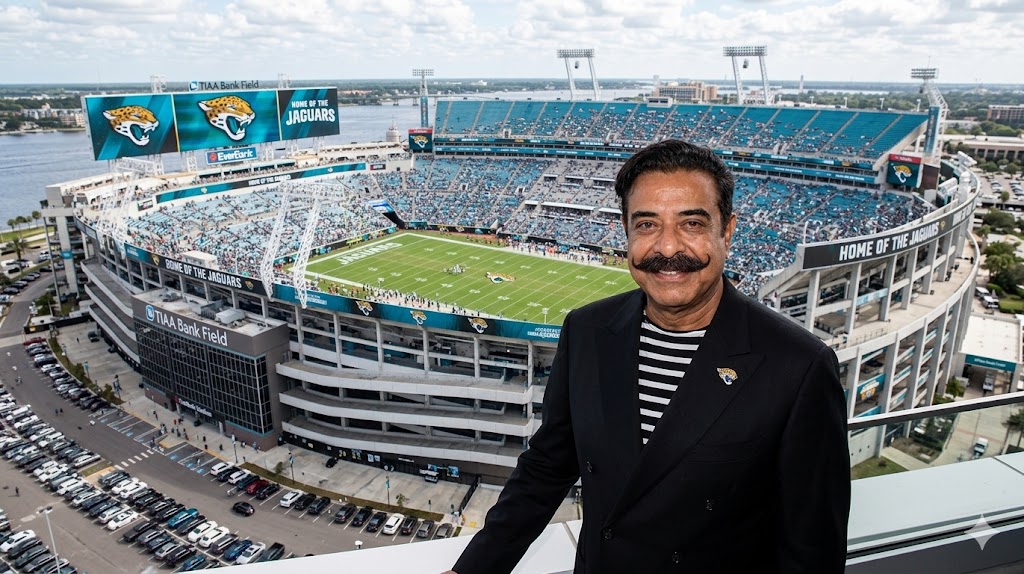
So the next time you drive past EverBank Stadium in Jacksonville, or you see a Jaguars logo, or you spot the man with the unmistakable handlebar mustache on TV — remember what he represents.
He’s not just a billionaire NFL owner. He’s a walking, talking reminder that the American Dream is alive and well. It just usually shows up wearing soaked shoes and asking where the dishes are.
Resources & Further Reading
- Jacksonville Jaguars: Shad Khan Owner Profile — Official team biography with details on his philanthropy and stadium projects.
- University of Illinois: “Khan Shares His Story of Success” — Long-form Peter King interview where Khan tells his early American story in his own words.
- Celebrity Net Worth: The Astounding Rags-to-Riches Story — Engaging deep-dive into Khan’s wealth journey.
- Forbes Profile: Shahid Khan — Real-time net worth tracking and business holdings.
About the Author