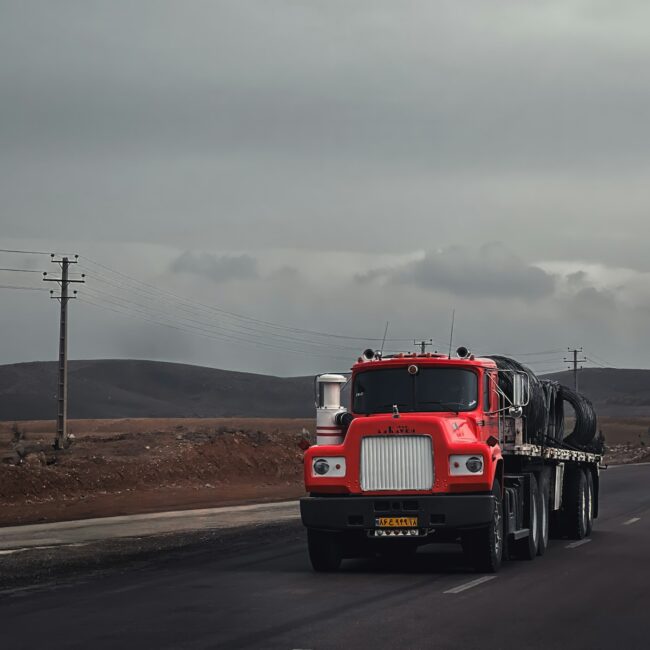
A flatbed semi truck on the highway. Photo: Alexander Popovkin via Unsplash, used under the Unsplash License.
Quick Answer: Jacksonville-based Landstar System reported third-quarter 2026 revenue of $1.51 billion, up 25.4% from a year earlier, as truck revenue per load rose 25.2%. Diluted earnings per share rose to $1.42 from $0.56, even as insurance and claims costs jumped 67.4% to $55.3 million, and the company raised its quarterly dividend to $0.44 a share.
Landstar System is one of the largest transportation companies headquartered in Northeast Florida. Instead of owning a large fleet of trucks, it runs an asset-light network built on independent sales agents, independent truck owner-operators it calls Business Capacity Owners, and tens of thousands of third-party trucking companies that haul freight through its brokerage operation. That model makes Landstar’s quarterly results a useful read on freight demand and trucking rates across the country.
The company released its third-quarter results on October 27, 2026. This article breaks down revenue, loads, pricing, insurance costs, capacity and cash returns based on Landstar’s earnings release filed with the Securities and Exchange Commission.
How did Landstar perform in the third quarter of 2026?
Landstar reported total revenue of $1,511.8 million for the quarter, up $306.4 million, or 25.4%, from $1,205.4 million in the third quarter of 2025. Operating income more than doubled to $65.5 million from $26.3 million, and net income rose to $48.0 million from $19.4 million.
Diluted earnings per share were $1.42, compared with $0.56 a year earlier. The prior-year quarter included an impairment charge equal to $0.66 per share, according to the release, which makes the year-over-year comparison look especially large.
| Metric | Q3 2026 | Q3 2025 | Change |
|---|---|---|---|
| Total revenue | $1,511.8M | $1,205.4M | +25.4% |
| Truck transportation revenue | $1,407.2M | $1,089.9M | +29.1% |
| Gross profit | $126.5M | $111.1M | +13.9% |
| Variable contribution | $212.1M | $170.2M | +24.6% |
| Variable contribution margin | 14.0% | 14.1% | -0.1 pt |
| Operating income | $65.5M | $26.3M | +149.0% |
| Net income | $48.0M | $19.4M | +148.1% |
| Diluted EPS | $1.42 | $0.56 | +153.6% |
Source: Landstar System third-quarter 2026 earnings release (Form 8-K).
Why did Landstar’s revenue rise so much?
The main driver was pricing. Truck revenue per load rose 25.2% to $2,811 from $2,245, while the number of truck loads rose only 3.1% to 500,650 from 485,430. In other words, Landstar moved slightly more freight and earned much more for each shipment.
| Equipment type | Q3 2026 loads | Change | Revenue per load | Change | Revenue | Change |
|---|---|---|---|---|---|---|
| Van | 294,875 | +6.1% | $2,577 | +22.8% | $759.9M | +30.3% |
| Unsided/platform | 128,398 | +4.2% | $4,039 | +29.0% | $518.6M | +34.3% |
| Other truck | 47,543 | +4.7% | $2,181 | +3.2% | $103.7M | +8.0% |
| Less-than-truckload | 29,834 | -23.2% | $836 | +32.7% | $24.9M | +1.9% |
| Total truck | 500,650 | +3.1% | $2,811 | +25.2% | $1,407.2M | +29.1% |
Source: Landstar System third-quarter 2026 earnings release.
Unsided and platform freight, the flatbed segment Landstar is known for, saw the biggest gains, with revenue per load up 29.0% and revenue up 34.3%. Van freight, Landstar’s largest category by volume, posted a 22.8% increase in revenue per load and 30.3% revenue growth.
Less-than-truckload volumes fell 23.2%, but higher pricing kept that segment’s revenue roughly flat.
How did other transportation modes perform?
Landstar’s non-truck businesses were mixed. Rail intermodal revenue rose 17.5% to $27.8 million, while ocean and air cargo revenue fell 23.4% to $55.3 million. Other revenue rose 9.7% to $21.5 million.
| Revenue source | Q3 2026 | Q3 2025 | Change | Share of Q3 2026 revenue |
|---|---|---|---|---|
| BCO independent contractors | $591.0M | $457.4M | +29.2% | 39% |
| Truck brokerage carriers | About $816.2M | About $632.5M | +29.0% | 54% |
| Rail intermodal | $27.8M | $23.7M | +17.5% | 2% |
| Ocean and air cargo | $55.3M | $72.3M | -23.4% | 4% |
| Other | $21.5M | $19.6M | +9.7% | 1% |
Source: Landstar System third-quarter 2026 earnings release. Truck brokerage dollar figures are calculated as total truck revenue minus BCO revenue.
What happened with Landstar’s insurance costs?
Insurance and claims expense was the main drag on the quarter. Costs rose 67.4% to $55.3 million from $33.0 million. The release said the total included about $13.0 million, or $0.29 per share, of adverse actuarial adjustments to reserves, and $8.0 million, or $0.18 per share, of prior-year claims development from settlements. Together, those two items equaled about $0.47 per share.
CEO Frank Lonegro said in the release, “We are not immune to the challenges of the insurance and claims inflation prevalent in our industry.”
For the first nine months of 2026, insurance and claims expense totaled $130.2 million, up 26.0% from $103.3 million. Measured against BCO revenue, third-quarter insurance and claims costs equaled about 9.4%, compared with about 7.2% a year earlier, based on the reported figures.
How did the results compare with expectations?
Revenue of about $1.51 billion was roughly in line with analyst expectations, but earnings per share fell short. FreightWaves reported that the $1.42 in diluted EPS was 24 cents below the consensus estimate, a miss it attributed to the $13 million in adverse reserve adjustments and $8 million of unfavorable development on two prior-year claims.
Lonegro put it this way on the earnings call, according to FreightWaves: “if you skip one line known as insurance and claims, you’d have a lot of good news.”
There was good news on safety. FreightWaves reported that Landstar’s accident frequency improved to 0.57 DOT-reportable accidents per million miles through the first nine months of 2026. The higher claims costs in the quarter were tied to reserve adjustments and the development of older claims, while accident frequency improved.
What a difference a year makes
The third quarter of 2025 looked very different. FreightWaves reported at the time that Landstar’s revenue was down slightly from the prior year, dry van revenue fell 3%, and van revenue per load was flat. Management then described demand as soft and expected a muted peak season.
| Measure | Q3 2025 | Q3 2026 |
|---|---|---|
| Revenue change from prior year | Down slightly (under 1%) | +25.4% |
| Van revenue per load change | About flat | +22.8% |
| Flatbed revenue per load change | Driven mostly by volume | +29.0% |
| Sequential BCO truck change | +7 | +165 |
| BCO turnover (trailing 12 months) | 31.5% | 26.6% |
| Insurance and claims as % of BCO revenue | 7.2% | 9.4% |
Sources: FreightWaves coverage of Landstar’s Q3 2025 and Q3 2026 results; Landstar System earnings release.
That swing from flat pricing to 20%-plus increases in revenue per load in a single year is the central story of Landstar’s 2026.
Is Landstar’s capacity network growing?
Yes, modestly. Landstar ended the quarter with 8,709 BCO trucks, up from 8,618 a year earlier, and 7,843 BCO independent contractors, up from 7,827. The company added a net 165 BCO trucks during the third quarter, which it described as the strongest quarterly improvement since the third quarter of 2021.
“I was highly encouraged to see our net 165 Business Capacity Owner (BCO) truck additions during the third quarter,” Lonegro said.
| Capacity measure | Q3 2026 | Q3 2025 |
|---|---|---|
| BCO trucks | 8,709 | 8,618 |
| BCO independent contractors | 7,843 | 7,827 |
| Truck brokerage carriers | 67,915 | 67,465 |
| Approved and active brokerage carriers | 39,460 | n/a |
| Total truck capacity providers | 75,758 | 75,292 |
Source: Landstar System third-quarter 2026 earnings release.
BCO-hauled loads rose 6.9% to 212,660, and BCO revenue per load rose 20.9% to $2,779. FreightWaves reported that BCO revenue per mile rose 23% for dry van freight and 19% for flatbed, and that BCO turnover improved 480 basis points from a year earlier to 26.6%.
The brokerage side of the network has shrunk over a longer period. According to FreightWaves, Landstar’s approved carrier list fell from more than 100,000 in 2022 to about 68,000, largely because of the company’s efforts to fight cargo theft and weaker truckload conditions, though the list grew 5% sequentially in the third quarter.
How is Landstar returning cash to shareholders?
Landstar increased its regular quarterly dividend to $0.44 a share from $0.40 a year earlier, an increase of 10%. The dividend is payable December 8, 2026, to shareholders of record on November 17.
The company also bought back 232,645 shares for $41.4 million in the third quarter, bringing year-to-date repurchases to 383,568 shares for about $64.0 million. It had authorization to buy 882,550 more shares.
The balance sheet remains conservative. As of September 26, 2026, Landstar held $297.3 million in cash and cash equivalents and $53.7 million in short-term investments, about $351 million combined, against $56.9 million of long-term debt. Trailing 12-month return on equity was 19%, and return on invested capital was 18%.
How did Landstar do over the first nine months?
| Nine months | 2026 | 2025 | Change |
|---|---|---|---|
| Revenue | $4,115.3M | $3,569.3M | +15.3% |
| Truck revenue | $3,823.3M | $3,257.8M | +17.4% |
| Gross profit | $371.4M | $318.6M | +16.6% |
| Operating income | $185.0M | $122.0M | +51.6% |
| Net income | $136.4M | $91.1M | +49.8% |
| Diluted EPS | $4.02 | $2.61 | +54.0% |
| Dividends per share | $1.24 | $1.16 | +6.9% |
Source: Landstar System third-quarter 2026 earnings release.
The third quarter’s growth was notably faster than the nine-month pace. Third-quarter revenue alone accounted for about 37% of the nine-month total, and third-quarter operating income for about 35%. Revenue grew 25.4% in the quarter versus 15.3% for the nine months, suggesting freight pricing strengthened as the year progressed.
What did Landstar say about October?
Landstar does not give quarterly earnings guidance, but it did share early fourth-quarter trends. FreightWaves reported that October truck loads were up 7% from a year earlier and revenue per load was up 29%, both slightly above the company’s historical sequential patterns. Landstar normally sees truck revenue rise about 1% from the third quarter to the fourth.
Management cited tight trucking capacity and data center construction as drivers of favorable demand, according to FreightWaves.
What does Landstar’s quarter say about the freight market?
Landstar’s results point to a stronger pricing environment for trucking in the third quarter of 2026. Revenue per load rose more than 20% across van, flatbed and BCO freight, while volumes grew in low single digits. For shippers, that means higher transportation costs. For carriers, it means better rates after a period of weaker pricing.
The insurance figures carry a separate message. Even in a strong pricing quarter, rising claims and reserve adjustments consumed a meaningful share of the gains, a trend Landstar’s CEO described as industrywide.
Why does Landstar matter to Jacksonville?
Landstar is one of Jacksonville’s best-known public companies, and its network of independent agents and truck owners extends across the country. Its results add to Northeast Florida’s profile as a logistics center, alongside the region’s port, rail and distribution operations.
For Jacksonville-area businesses, the key signals are:
- Freight rates rose sharply. Shippers should expect higher trucking costs if the third-quarter pricing trend holds.
- Flatbed demand is strong. Platform revenue per load rose 29%, and management cited data center buildouts among the drivers of demand.
- Insurance costs are a sector-wide pressure. Claims inflation is affecting even well-capitalized carriers.
- Cash returns are rising. The 10% dividend increase and $64.0 million in year-to-date buybacks show management’s confidence in cash generation.
- Owner-operator capacity is growing again. Landstar’s best quarterly BCO truck gain since 2021 suggests more drivers are joining its network.
Brian’s Take
What stands out to me in Landstar’s quarter is how fast the freight cycle turned. A year ago, management was talking about soft demand and a muted peak season, and van pricing was flat. This year, revenue per load is up more than 20% across most of its equipment types, and October was running even hotter.
The insurance line is the reminder that a better freight market does not fix everything. Claims costs rose faster than revenue, and the company missed analyst estimates because of them. Still, a business with about $351 million in cash and investments against $56.9 million of long-term debt has room to absorb that. For Jacksonville, it is good to see one of its hometown companies riding a stronger freight market.
Frequently Asked Questions
How much revenue did Landstar report in Q3 2026?
Landstar reported third-quarter 2026 revenue of $1,511.8 million, up 25.4% from $1,205.4 million a year earlier.
What were Landstar’s Q3 2026 earnings per share?
Diluted earnings per share were $1.42, compared with $0.56 in the third quarter of 2025, which included an impairment charge of $0.66 per share.
Why did Landstar’s insurance costs rise?
Insurance and claims costs rose 67.4% to $55.3 million, including about $13.0 million of adverse actuarial reserve adjustments and $8.0 million of prior-year claims development.
How many trucks does Landstar have in its network?
Landstar had 8,709 BCO trucks operated by independent owner-operators at the end of the third quarter, plus 67,915 truck brokerage carriers.
What is Landstar’s dividend?
Landstar declared a regular quarterly dividend of $0.44 per share, up from $0.40 a year earlier, payable December 8, 2026.
What did Landstar say about October 2026?
According to FreightWaves, Landstar said October truck loads were up 7% and revenue per load was up 29% from a year earlier.
Where is Landstar headquartered?
Landstar System is headquartered in Jacksonville, Florida.
Sources and Further Reading
- Landstar System, Inc. Reports Third Quarter 2026 Results (Form 8-K, Exhibit 99.1), October 27, 2026 — Landstar System, Inc. / U.S. Securities and Exchange Commission
- Insurance Claims Adjustments Tank Landstar’s Otherwise Strong Q3 — FreightWaves
- Flatbed Trends Buttress Landstar Amid Dry Van Slump — FreightWaves
About the Author